Showing posts with label visual system. Show all posts

Tuesday, March 3, 2015

Jaw clenching, Vision Therapy and earthquake resistant structures

Personally I learn a lot from reading/listening up on vision rehab and anatomy but I learn just as much from having conversations with other strabismics. I think it's a practice that could be useful to anyone with any problem. Don't compare yourself to people with a very differing, in this case neurological, background. Learn from people who are similar to you and dealing with similar day-to-day problems. What follows is a blog post constructed on this type of conversation.

PASQUALE: Hi Michael, in many blog entries you mention jaw clenching. I too have said that I engage numerous facial muscles while I try converging and diverging at different targets.  It feels like the brain is recruiting other muscles because it still hasn't figured out how to properly use the eye's extra-ocular muscles.

MICHAEL: I always think of it like learning how to do something with your left arm (unless you are left-handed). First you use your entire arm, often in a contorted way. Then you move on to more specialized movements of the joints and ultimately you can do things smoothly having very fine control over your arm, hand and fingers. Theoretically the potential for improvement is limitless.

Let's transpose this to the visual realm. At first, when trying to accomplish a visual task, you are doing it very clumsily and inefficiently. Your brain is trying to accomplish a task which requires fine ocular motor skill but it's not succeeding because of a lack of (lasting) control. Because many of us are hardheaded we redouble our effort and adjacent regions and resources like facial muscles are drawn into the process to little or no avail. Not good. Instead of redoubling our effort employing a very limited set of visual skills we should go back to the drawing board and improve and multiply our skills. Technique is more important than 'brute' force.

The visual system involves six of the the twelve cranial nerves. That's a lot of guns to fire and potentially misfire. When I experience jaw clenching after too much reading or just a visually or otherwise stressful situation, that implies I've gone beyond my current visual skill level and I need to back down.

Trigeminal nerve - 5th cranial nerve

PASQUALE: Have you figured out exercises that eliminate engaging other muscles except for those needed to coordinate the various components of the eyes.

MICHAEL: Well, any activity that encourages 'the eyes', meaning the appropriate muscles and neural processes associated, to do the work without recruiting other muscles. That implies not going too far beyond your current skill level and paying a lot of attention without getting frustrated. For me it means slowing down and lowering expectations while gathering finer motor control. As long as my jaw doesn't clench, I'm in the safe zone. Once I start hurting, I'm overdoing it. It's not always easy to be patient and sometimes there are just visually stressful tasks I have to deal with. Then I'm tired, dizzy and in pain.


When thinking about this problem I'm reminded of something I learned about earthquake resistent structures. There's no such thing as a completely earthquake resistent building but you can improve a buildings capacity to withstand external shifts to a large extent. There are various approaches you can adhere to when going about the seismic retrofitting of a structure.
- You can increase the global capacity of a structure. (strengthening)
- You can isolate the foundation so the structure can shake on it. (partial flexibility)
- You can impose intelligent structural changes. Structural vibration control technologies minimize forces and deformations. (flexibility)
The last option implies that various individual parts of the building can move or flex allowing for shock absorption.

Vision Therapy is akin to a seismic retrofit for the visual system. You make structural changes in how it works and learn how to control and flex individual parts. You learn to lean into a quake rather than stiffening up.  That way you can withstand more external demands, with reduced energy drainage and avoid collapse of the structure/system.


For me, eye teaming remains a big challenge but I'm getting there. A related challenge is to gain more independent control over vergence and accommodation, i.e. taking on any binocular stance while manipulating my eye lens as I please. Either component should have limited effects on the other one's performance and there should be a certain ease in doing this. Just like using indivudual fingers while playing the piano.  An increased 'isolation' of these visual components gives more freedom of movement. To continue the piano anology, you'll be able to play 'visual Mozart' instead of just hitting the keys indiscriminately with all fingers at once.

As far as particular exercises are concerned, there are plenty of options to choose from if you understand the underlying principle. Magic eye stereograms, prism/spherical flippers, Eccentric Circles, Aperture rule, even just playing freely with your vision, ... Many VT practices are grafted on this idea one way or another. They are looking to improve smooth eye teaming, lens focusing and then increasing skill level by adding more activities (balance, body coordination, cognitive skill, ...).

In that respect, I particularly liked a quote from the interview I did with Mark last month. It illustrates this point very nicely.
MARK: I still have strabismus but I have a greater degree of control. The reduced suppression helps. I can line everything up that I need for stereopsis (fixation on an object, in focus, no suppression, awareness of peripheral vision etc.). It can be an enormous effort but it's like any other form of learning. Repetition is the key and progress, however slow, will be made!
The only catch 22 when talking about all this 'control' is that you won't necessarily attain it by going about this like a control freak. Be relaxed, patient but determined.

One month later... 

PASQUALE: It has taken me over eight months to finally feel that my brain can move my eyes with better coordination without trying to recruit a battery of other facial, non ocular muscles. I have gone through an entire slew of other muscles including those around the temple region, jaw, even moving my ears. The worse was when I actually felt my upper jaw putting tremendous stress on my entire skull as if trying to separate one from the other. I have to say that I see more positive progress now that my brain isn't trying to move my eyes through the recruitment of all those other muscles.

Thursday, October 30, 2014

The vestibular system and vision

I've been reading up on the link between vision and the vestibular system. It's been quite instructive to say the least. Of course it's annoying not to be able to align the eyes and have double vision while reading etc... However, there's more. It's very interesting how compromised eye movements, in large part due to eye muscle surgery, and consequently a compromised Vestibulo-Ocular Reflex are likely to be the biggest source of disability and fatigue for me personally. When going beyond my relatively low visual endurance limit, the sensory conflict between the visual and the vestibular gets exacerbated. It sometimes feels like being drunk and can even give me something resembling to a hangover later on. Not merely alignment of the eyes but also the integration of these ocular motor skills with the vestibular system will be crucial in terms of lasting vision therapy results and daily functionality.

What is the vestibular system?

- Peripheral
The term 'vestibular' comes from the Latin 'vestibule' which means room. This 'room' is located in the inner ear and contains a minute amount of chemical fluid. Its workings involve the detection of fluid movement by receptor hair cells in various differently oriented semicircular canals. Vestibular injury may or may not be accompanied by hearing loss.


- Central
The vestibular sense is often misunderstood or overlooked. That's because, for instance, there is no such thing as a primary vestibular cortex.

'There is, rather, a complex of cortical targets many of which remain difficult to understand. From the brainstem, vestibular signals reach a subcortical structure called the diencephalon. Tucked in between the cerebral hemispheres the diencephalon houses such important structures as the pineal gland, hypothalamus, and thalamus. Compared to the cerebral cortex the diencephalon is small in size but is very rich in nuclei for sensory, motor and limbic pathways. The thalamus is a central relay station for all incoming sensory signals excepting olfactory information.' - Vision Rehabilitation

Without going into detail, we can conclude this sense is for a large part located in the primitive,  reptilian part of our brain which houses many basic but vital functions. In fact, this sense is so essential to our functioning and well-being, that the vestibular nerve is the first fiber tract in the brain to begin myelination during pregnancy. This process starts by the last week of the first trimester. By the end of the fifth month of pregnancy, the vestibular organ has reached full size with ongoing myelination of pathways to the eyes and the spinal cord.

- Function
Whereas the anatomy and chemistry of the vestibular system itself are fascinating, its interaction with the visual system and other somato-sensory systems are even more interesting.

The vestibular system is responsible for
(1) detecting linear and angular head movement and head position in space;
(2) assisting gaze stabilization of the visual field;
(3) maintaining balance and postural control; 
(4) providing spatial orientation or perception of body movement.

The primary role of the vestibular system is to provide the brain with information to regulate posture and to coordinate eye and head movements. Proper vestibular functioning and integration with the other senses is of major importance to good overall health, optimal functionality and vision.

Link with vision?

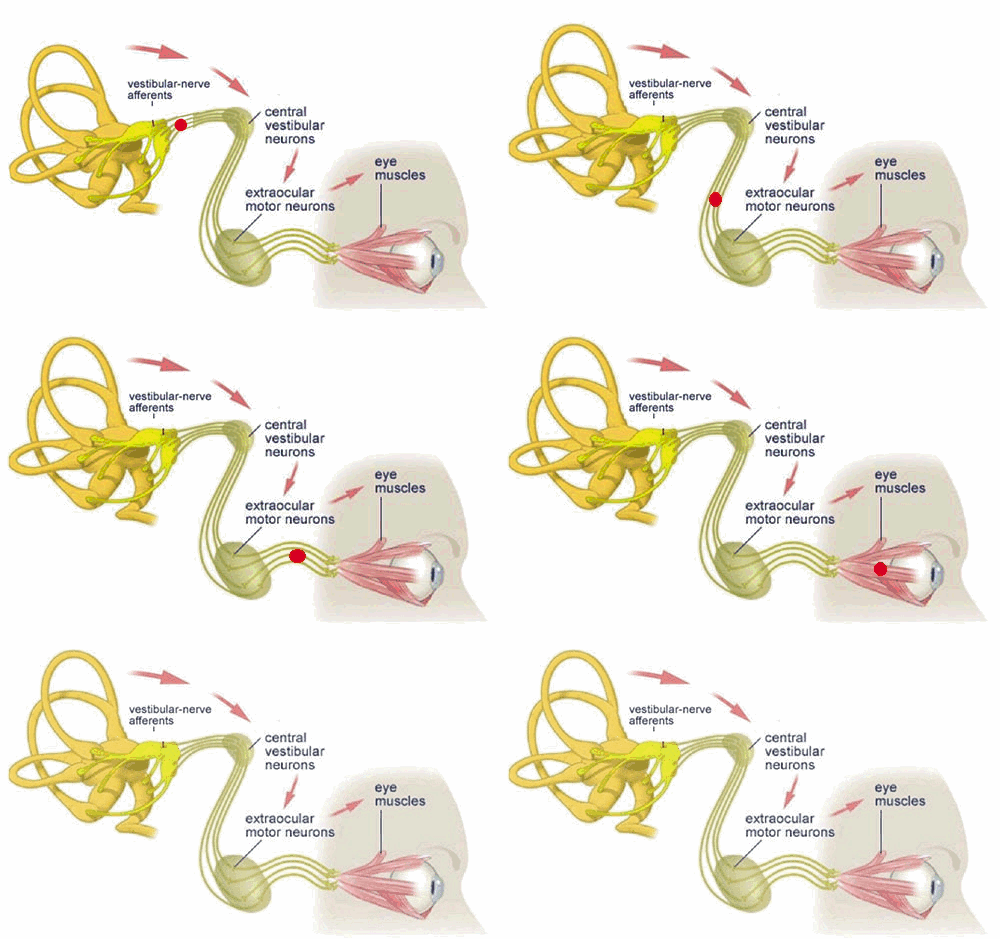
'The vestibular system plays an important role in the generation of eye movements that compensate for head movements. Through vestibular nuclei in the brainstem, each SCC (semi-circular canal) is able to communicate with motor neurons of extra-ocular muscles to cause eye deviation in each canal’s own plane. This interaction is the basis of the vestibuloocular reflex (VOR), which stabilizes gaze upon an image or the visual world during head movement. If the VOR is impaired, loss of gaze stabilization is the result. For example, as the patient turns the head while walking an object in the visual field or the whole visual environment appears unsteady or “bouncing.”

Demer described the VOR as a “synergistic” interaction between the vestibular and ocular systems. Normal VOR stabilization is needed for “functional vision, and vision optimizes the performance of the VOR”. Dynamic visual acuity (DVA) plays a role in maintaining a sharper image on the retina, while the VOR steadies gaze during head movement. This interaction is called the visual vestibuloocular reflex (VVOR).' - Vision Rehabilitation


And in turn...

'Sensory receptors in the eyes provide important feedback regarding orientation of the body in space. In other words, where is the head in relation to the horizon? As discussed in Chapters 5 through 7, dysfunction in the visual perception of “straight ahead,” common following brain injury, can cause dizziness, disorientation, and imbalance. In the process of orientation, visual input also provides information regarding possible environmental hazards, barriers or avenues of escape. In the presence of impaired inputs from either the somatosensory (sensory projections from all over the body) or vestibular or both systems there is a strong dependence upon visual input. Defective input from one of the three systems (visual, proprioception/somatosensory, vestibular) may be compensated for by the remaining intact systems such that the patient is able to function, albeit with some discomfort and loss of efficiency. However, dysfunction in two of the three systems will result in significant disability.' - Vision Rehabilitation

Problems?

Even though the vestibular sense might often be overlooked by physicians, one will be made aware of its existence in case of dysfunction.

- Inappropriate nystagmus
'Spontaneous nystagmus, occurring when the head is static (still), is an indicator of acute peripheral vestibular loss. Nystagmus is often along the horizontal plane. Vertical or torsional spontaneous nystagmus usually indicates a direct injury to the brainstem. The cause of this inappropriate nystagmus is a direction-specific imbalance in the VOR as brainstem neuronal circuitry is activated. Inappropriate nystagmus may also be related to medication toxicity, such as some antiseizure medications.' - Vision Rehabilitation

Inappropriate nystagmus may also be provoked by head shaking and indicates an imbalance of dynamic vestibular function.

An indicator of inappropriate nystagmus of central origin, caused by brain dysfunction rather than dysfunction of the peripheral organ, is often the inability to inhibit nystagmus with visual fixation.


- Dizziness
Feeling disoriented, especially in dark areas, or feeling spacey, floating, rocking, or lightheaded. Dizziness is not always related to vestibular dysfunction but may indicate non-vestibular causes, one of which being visual disorders. However, when dizziness is mentioned, involvement of a vestibular dysfunction must be considered.

- Vertigo
Even though dizziness and vertigo are often used interchangeably, technically there is a difference. Vertigo refers to the illusion of movement, typically rotational, when no actual movement is observed. True vertigo refers to vestibular system involvement.

- Motion sickness
What causes motion sickness?

'There is a hierarchical preference to rely on visual input more than any one of the other two systems (vestibular, proprioception) involved in balance. Vision, as proposed by Bronstein, had a dominant role or “hierarchical preference” over proprioceptive input in the process of maintaining upright posture and balance. However, Mallinson et al. suggested that a “visual preference strategy” would not apply to some individuals who have an intolerance for any disagreement between visual and vestibular signals. Paige had previously called this disagreement between the two systems as a “visual vestibular mismatch” (VVM) and others referred to it as a “sensory conflict.” By 1996, the “sensory conflict” theory for the development of motion sickness had been accepted within the scientific field studying this subject.' - Vision Rehabilitation

- And more...
Balance problems, gait ataxia, ...

Of the top of my head I can think of two interesting cases I read about involving vestibular dysfunction.

In the book 'The brain that changes itself', Norman Doidge described a woman who felt like she was perpetually falling due to vestibular injury.   Her vestibular organ was damaged but her central vestibular processing capabilities were intact. We can't even start to imagine how she felt. It completely ruined her life. Until a certain Doctor thought of the idea to supply her brain with 'vestibular input' in a different way. He connected an accelerometer to a tongue outlet which gave her a certain signal depending on the direction towards she was falling. Through the mechanisms of brain plasticity she learned to ignore her vestibular organ and to stabilize herself using this new input stream. Somehow over time, as her brain re-calibrated, she became less dependent on the device and needed it less and less.

Another vestibular story was featured in Oliver Sacks' 'The man who mistook his wife for a hat'. A Parkinsonian, 93 year old, retired carpenter whose vestibular sense had become more and more unreliable started walking tilted over to one side without knowing it. His senses deceived him until he saw himself on camera. He was speechless. After this discovery he wondered whether he could apply the mechanism of a spirit level to his problem. He designed a pair of glasses including some sort of spirit level which he could then use to teach himself to walk upright again. Essentially he retrained his impaired vestibular system using visual feedback. At first it took a lot of conscious effort but later on it got easier and easier. Just like learning how to drive a car.

Psychological impact of vestibular dysfunction

'There are a variety of reasons why patients suffering from episodes of vertigo develop anxiety, depression, poor self-esteem, and a growing sense of disability. The fear of falling or the fear of heights is common. Concern for a sudden onset of vertigo and the loss of control in public venues often leads to avoidance behaviors or “safety-seeking behaviors,” as coined by Gurr and Moffat. The appearance of staggering, falling, and confusion may lead observers to believe that the person is intoxicated. The patient soon finds him/herself avoiding social events and staying home to avoid embarrassment. Physical activity is avoided for fear of provoking an episode.' - Vision Rehabilitation


Testing

- Static and dynamic balance testing. Dynamic balance tests require input from the Vestibulo-Ocular Reflex to stabilize the visual field and make rapid adjustments in posture. Dynamic gait, sit-to-stand, ...
- Dix Hallpike maneuver
- Bithermal Caloric irrigation test (COWS): spraying water in the ear. Check it out on Youtube. It's pretty cool.
- Comprehensive Vision Testing: gaze, tracking, binocular vision, perceptual, functional, nystagmography, ...

Please read Chapter 9 of 'Vision Rehabilitation' for more detailed information. 

Rehabilitiation of the vestibular system

Vestibular injury or dysfunction can impose dramatic alterations in a patient’s once active lifestyle. There will be occasions when medication can be helpful in the short term. Surgery is the rare choice. Therapists take caution when a patient has other disabilities (brain trauma, stroke, peripheral neuropathy, spinal conditions, and/or vision disorders), which may limit choices of exercises.

'A key factor in achieving the best outcome will be patient compliance. Education is the greatest tool used by a good therapist to engage a patient’s willing participation in what is usually a difficult treatment program. Between, both, the vestibular therapist and the psychotherapist the patient is assisted in understanding the basics of the dysfunction: Why symptoms occur; the emotional response; and how treatment should help. Initial treatment typically provokes unpleasant symptoms but feeling worse comes before feeling better. Another factor in achieving the best outcome involves adequate intensity and duration of the treatment program.

Progression of function is the best gauge for the effectiveness of treatment. The process of treatment involves strategies for adaptation and substitution by using other strategies, habituation (desensitization), and retraining of balance. As the patient is able, exercises are expanded to include cardiorespiratory conditioning. Goals of vestibular rehabilitation are to (1) optimize compensation in the balance system; (2) habituate abnormal vestibular responses to rapid movements; (3) reduce fall risks by improving balance and postural control; and (4) educate the patient.' - Vision Rehabilitation

Is it a vision problem or vestibular problem?

It's important to figure out whether you are suffering from a vestibular problem with a visual component or a vision problem with a vestibular component. For strabismics who identify with some of these issues, the answer is probably 'a vision problem with a vestibular component'.

That is why in the more advanced stages of Vision Therapy you are not only training eye movement. You are to stimulate your way towards overall sensory and thus vestibulo-visual integration. There's a million ways to skin that cat. Some of the things I do as vision therapy loading: walking, head turns while attempting to keep my gaze stable, walking a beam with yoked prisms, balance board, jumping on a trampoline, standing on my head, running, ...

When my vision tends to go blurry or double and I feel dizzy, it's time to take a break. I flirt with my limit, take sufficient rest and remind myself that sometimes you do have to feel worse before feeling better. Improving these elementary vestibulo-ocular skills does influence and improve more sophisticated and more cognitively taxing ocular motor activities such as reading. The ground is being prepared!

Sunday, April 27, 2014

Head rotations, bar reading and bring on the prism flippers

Head rotations
Last week, for the first time, I had a completely stable percept while doing my head turns. I couldn't believe it!  I thought I was suppressing or something but I wasn't. Both eyes were just heedlessly adjusting to the head movements without error. It must be great to be able to take these reflexes for granted! I had predicted this milestone for the end of April et voila. Another hurdle taken. The reflexes are not equally reliable every day but that, again, is a matter of time.

Speaking of head turns... I'm reading this awesome book called 'Vision Rehabilitation: Multidisciplinary care of the patient following brain injury' which I will review properly later on. It had some interesting things to say about the anatomy of vision and head rotations.

The cortical or supranuclear influence on gaze is carried out by six distinct neural networks: (1) the saccadic eye system directs the fovea from one object to another object of interest; (2) smooth pursuits hold the image of a moving target on the fovea; (3) the vergence system acts to move the eyes in opposite directions (i.e., convergent and divergent) so that the image of a single object in space can be placed simultaneously on the fovea; (4) vestibulo-ocular holds images still on the retina during brief head movements driven by signals of the vestibular system; (5) optokinetic system holds the image still insofar as possible during sustained head rotation or watching a sustained stimulus going by, such as a train; and finally (6) the fixation system holds the fovea in place on a stationary target. These complex supranuclear networks result in eye movements coordinating whole muscle groups. With the exception of the vergence system, supranuclear eye networks mediate conjugate eye movements. Thus, other than vergence system disorders, supranuclear damage does not lead to diplopia, but to restrictions of conjugate gaze, as in loss of upgaze or downgaze.

Misalignment of the two visual axes with complaints of diplopia frequently results with lesions involving the infranuclear portion of the gaze system, including Cranial Nerve III, IV, or VI or the myoneural junction or extraocular muscles they innervate. Intranuclear lesions also result in diplopia. Innervation of extraocular muscles is ipsilateral to the CN nucleus for CN III and VI, and contralateral for CN IV. The infranuclear ocular motor system is a complex motor system requiring the coordination of twelve muscles to move the eyes.

So there you have it then... I've got problems with the supranuclear, ifranuclear and intranclear portions of the gaze system but the head rotations are on their way! :D In my case it was not a traumatic head injury but a combination of uncorrected developmental weakness and bad surgical intervention. The result for the visual system however is the same. I remember a number of ophthalmologists/strabologists giving me some spiel about third cranial nerve palsy 'with unknown cause'. Yeah, sure mate... Unknown cause. After the surgery there was not only horizontal misalignment but also vertical misalignment meaning the stress on that nerve had increased because the muscles had become so much harder to operate. Vertical alignment also meant that now CN IV had become affected. Overall visual stress on the visual system had become too much to bare as some parts of the system had been ignored and neglected whereas other parts had been damaged in surgery.


Bar reading
I'm a bit repetitive in my mentioning bar reading. I just love this exercise. Nowadays I just wake up, eat something and spend an hour or so bar reading until I get tired. Not completely exhausted though. Up until the point that I still got some juice left but it's time to go for some less visually stressful activities as the day progresses. The hardest part about bar reading is to stop and wait until the next day so I can do it all over again. That's just because I love reading too. I've gone from zero pages at the beginning of this year to 14 to 15 pages a day by the end of April. Hopefully things keep progressing at this pace. It's much more fun to read properly and binocularly than to read in a half assed way. The bars keep you tied up in a 'binocular straight jacket' preventing you from falling back to double vision and visual confusion. Reading while experiencing double vision and visual confusion feels like you are hurting yourself and giving yourself a headache on purpose. I've done this many times to study the things I needed to know to survive but it's not the way to live your life in the long haul. When my bar reading juice is up for the day, I resort to text to speech software, audiobooks or other normal day activities which can include less cognitively taxing forms of visual exercise.


Bring on the prism flippers
To enhance the bar reading progress and the elimination of my remaining convergence insufficiency I'm going to start using prism flippers by the end of May. Making it a little harder yet again. Going to the next level. The new normal.


Saturday, November 30, 2013

Book Review: 'The story of the human body: Evolution, Health and Disease' by Daniel E. Lieberman - Strabismus from an evolutionary biology point of view

Note: This review contains two sections. The first half of this article reviews the book from a general perspective while the second half deals with the book's implications to vision care and strabismus in particular. Each can be read separately according to your interest but of course you are more than welcome to read the entire review. Enjoy!


"Nothing in biology makes sense except in the light of evolution." ,- Theodosius Dobzhansky

In the first half of the book Lieberman kicks off with a detailed history of how we got to be Homo Sapiens and how every mutation came into being and why. Oftentimes it was climate change or some other major event our hominin ancestors managed to survive at the time. It also magnificently reveals why we are the way we are and why we move the way we move. I leave it up to you to read the book if you want the full story on that. What stood out to me is how seemingly random it all happened and how the evolution of the modern human was not inevitable. It's like we 'won the lottery'. I will leave the philosophical debates up to you, but if you can't handle the fact that we are bipedal primates the book is not going to be much fun for you.  A great quality of his narrative is that he doesn't try to oversell and clearly states what actually can be known by examining the evidence and what are merely hypotheses. For instance, one of the many cool fun facts is that even though Neanderthals have died out, 5% of the DNA we carry has Neanderthal origins due to interbreeding. Also notable, and something every human ought to know, is the fact that we are a genetically homogenous species and apparent differences in looks are literally only skin deep.

In short, it's been an interesting last 6 million years and you are the result. Compared to the entire duration of human evolution, the agricultural revolution and later the industrial revolution are merely blinks of the eye. Agriculture was only invented around 11,000 years ago.  Farming is often viewed as an old-fashioned way of life, but from an evolutionary perspective, it is a recent, unique, and comparatively bizarre way to live. This new cultural revolution occurred for good and valid reasons and were mostly beneficial at first. The best way to investigate the effect of past events on the human body is by comparing bodily remains of hunter gatherers and early farmers. Initially height and health of farmers increased. Later on, because of various reasons one of which is population increase, farming was still a boon for the human species as a whole but became a mixed blessing for the individual. Over time farming exposed people to dangerous situations like famine, living of solely one crop and a much higher rate of infectious disease due to higher population and animal densities. In other words, the unfortunate irony of agricultural intensification is that even though farmers produced more food overall, the energy available for each child to grow diminished, probably because they were spending relatively more energy fighting infections, coping with occasional shortages of food, and toiling long hours in the fields.

Ever since the agricultural revolution culture has undergone increasingly rapid change to this day. Through cultural evolution rather than natural selection we have learned how to cope with many of the unfortunate side effects of our new farming life style. The book goes on to describe the industrial revolution and  how new divides between our biology and cultural evolution came to be and how medical advance often spectacularly helped mitigate the effects of many mismatches. The author also provides interesting insights in how the modern food industry originated and works. We are further removed from our 'normal' habitat than ever before and without looking at our own biology through an evolutionary lens we are unaware of the possible risks this entails. Not because I consider something 'normal', it is actually normal. Humans have a habit of making new habits without even knowing it. In fact, cultural evolution is taking on such speeds that what was normal to my grand parents and even parents is vastly different from what I consider normal. Increasingly we are creating novel environments for which our ancient genes did not evolve. Even though natural selection is still ongoing, there is no way it can keep up with the blistering pace at which our environments are changing. However smart we are, or we think we are ,we are still a bunch of monkeys whose proliferation and cultural development got 'out of hand'. Now, the good news is that at this time in history we can start relearning some of our monkey ways to combat health problems our body is developing in response to this profoundly new and weird environment. How awesome is that!
We therefore have much to gain by using the lens of evolution to consider shifting gene-environment interactions that have occurred since the Paleolithic ended. How well do the genes and bodies we inherited from our early modern human ancestors fare in the novel environments to which we subject them? And how can an evolutionary perspective on these changes be of practical use?...
The emerging and important new field of evolutionary medicine proposes that,despite much progress since the Paleolithic, we have become like that (out of place) animal in some respects. As innovation has accelerated, especially since farming began, we have devised or adopted a growing list of novel cultural practices that have had conflicting effects on our bodies. On the one hand, many relatively recent developments have been beneficial: farming led to more food, and modern sanitation and scientific medicine led to lower infant mortality and increased longevity. On the other hand, numerous cultural changes have altered interactions between our genes and our environments in ways that contribute to a wide range of health problems. These illnesses are mismatch diseases, defined as diseases that result from our Paleolithic bodies being poorly or inadequately adapted to certain modern behaviors and conditions....
The most basic interactions between culture and your body’s biology are the ways that learned behaviors—the foods you eat, the clothes you wear, the activities you do—alter your body’s environment, thus influencing how your body grows and functions.

To be clear, this book does not propose to resort back to our caves and give up advances that have allowed people to survive throughout human history. Today 800 million people are often still struggling to get sufficient food. Yet at this time the number of obese people world wide has exceeded one billion. Affluence seems to have its own risks since we did not develop to deal with abundance and nowadays healthy food is more expensive than junk food. So those of us fortunate enough to live in the developed world are developing all kinds of new problems. Because people have no idea anymore about what is 'normal' our daily activities and foods without moderation can lead to debilitating illnesses.
Another application of evolutionary medicine is to recognize that many symptoms are actually adaptations, thus helping doctors and patients rethink the way we treat some illnesses and injuries. How often do you take an over-the-counter medication at the first sign of fever, nausea, diarrhea, or just aches and pains? These discomforts are widely regarded as symptoms to alleviate, but evolutionary perspectives indicate that they can be adaptations to heed and put into service. Fevers help your body fight infections, joint and muscle pains can be signals to cause you to cease doing something harmful like running incorrectly, and nausea and diarrhea assist you in purging harmful bugs and toxins.

Quick fix solutions can be great when dealing with acute health problems, but we could do a far better job in preventing most of those ailments to begin with. Lieberman does not discard the impressive medical advances accomplished during the last centuries and how they enable us to survive acute health problems. He just points out we can have best of both worlds. If we start being aware of the risks of some modern behaviors and know how to manage them adequately we could be much better off. When illness logically finds you because of the way your biology interacts with some behavior or foods, many doctors often deal with the symptom, rather than come up with a structural solution, starting costly negative feed back loops aggravating the problem in the long haul. While as a matter of fact some ailments can simply be prevented or treated by changing behavior.

(Some medical treatments) are not so much solutions as Band-Aids that treat only the symptoms of mismatch conditions. Such palliative responses can create a problem, because treating the symptoms rather than causes of mismatch diseases sometimes provokes a pernicious feedback loop, which I term dysevolution, that allows the disease to persist or even intensify. ...
Many medications are available for treating hypertension, but the best treatment is also the best form of prevention: good oldfashioned diet and exercise. Therefore, like cavities, high blood pressure is a common case of dysevolution because even though we know how to lessen its prevalence, our culture creates and passes on the environmental factors that cause the condition and keep it common. As chapters 10 through 12 explore, similar feedback loops help explain the incidence of type 2 diabetes, heart disease, some forms of cancer, malocclusions, myopia, flat feet, and many other common mismatch diseases.

To get the full benefit of the illuminating descriptions of mechanisms through which very 'normal' or common behaviors might contribute to those ailments I recommend for you to read this book. When reading some books I really feel privileged to acquire the knowledge offered by that particular book and this is one of those books. I'm happy to have learned this information so I can make informed decisions in the future. Nevertheless I will come back to myopia later in this review.

Towards the end the author points out this shift in health care is not going to be easy. It's very profitable to sell comfortable objects and foods we instinctively 'can't get enough of'. Moreover, the medical system is skewed in such a way that it promotes all kinds of accommodating gear, medication and expensive surgeries. Behavioral change is much less profitable and harder to sell. One often has to be really well-informed and have a healthy dose of skepticism towards doctors to find out about more structural long term solutions. Clearly this is no different in the vision care business. In the final chapter, he proposes various policy adjustments and how he thinks they would play out in trying to improve general prevention efforts taking into account our ancient cravings for comfort and 'unhealthy' foods and our new environment. Sadly much money is being spent on keeping negative feedback loops going rather than preventing them from occurring. Preventive medicine is not only the best kind of medicine, it's also the cheapest kind.
The dramatic successes of pediatrics during the twentieth century prove that preventive medicine really is the best medicine. My (the author's) grandfather (who was a doctor) died in the early 1980s, but I am sure he would despair at the state of preventive medical care for children today in the United States. The majority of American children still get regular checkups, inoculations, and dental care, but 10 percent of them don’t because of poverty and poor access to health care. The percentage of low birth weight babies, now 8.2 percent, has not declined in decades and in fact has been rising recently, even though low birth weight substantially increases a child’s risk of dozens of short-term and long-term health problems. In 1900, Americans were, on average, the tallest people in the world, but today they tend to be shorter than most Europeans.

STRABISMUS CONSIDERED AS A MISMATCH DISEASE

"It is virtually impossible to see how biology works outside the context of environment.", - Robert Sapolsky, Stanford University

To me binocular problems or strabismus are one of the most clear cases of a mismatch disease. I have a very hard time believing one could have genes that predispose you 100% to be cross-eyed. I have some papers lined up about strabismus and genetics but I doubt that they will be very earth-shaking in that respect. Even if there is such a thing as a 100% genetically predisposed strabismic, it will be a small minority among the actual strabismics.

A good point about using an evolutionary perspective is that when studying a phenomenon we shouldn't compare someone with a particular disease to a supposedly healthy person who grew up in an industrial environment. To really get an idea of what is 'healthy and normal' we should try to learn from the bodily evidence that our paleolithic ancestors left us. That would be a whole other story since nothing in biology makes sense unless seen in light of evolution.

For instance, the visual system must have evolved over millions of years in order to make us excellent hunter gatherers. Distinguishing colors, having a good panoramic overview of landscapes, judging distance, interacting vigorously with the world resulting in an agile and flexible visual system. I'm working on a blog entry on 'loading', meaning the application of learned visual skills during Vision Therapy in real life activities. I think hunting and gathering would be an excellent form of 'loading'.

Knowing this, writing and reading are a fairly 'risky' new behaviors and was only invented 6,000 years ago. In his book 'The Mind's Eye' Oliver Sacks ponders the question how we managed to invent script, reading and writing from a neurological perspective. He proposes that we didn't evolve to read and write but rather that we 'recruited' brain areas that evolved for other practical uses which eventually enabled us to invent something completely new by combining them. I am the first person to marvel at such ingenuity but advanced behavior like reading are are not really 'normal' in the evolutionary sense of the word. Obviously the benefits of reading outweigh the risks and it has brought us plenty of good. Nonetheless reading could be even more beneficial to mankind if we learned how to manage the risks it brings to the human visual system. A problem can be caused by environment and behavior so it can also be solved by environment and behavior such as visual training.

The author did mention the myopia epidemic that sweeps the globe as a result of intensified reading and electronics use. He clearly understood the idea of how and why vision changes. But I would almost say myopia is a 'beneficial' adaptation to our new environment which in general leads to easier reading, higher income and more socio-economic success. So it is clear our new environment brings out more myopia in those genetically predisposed to it and cultural innovation like glasses and invisible contacts help them cope. However, extreme myopia too can be managed through accommodation training and life style changes.

That being said, Lieberman didn't seem to realize there are far more crippling and fundamental evolutionary vision mismatches in our day and age. Myopia is basically cramping of the ciliary muscle in the eye making it hard for one to adjust his eye lens. My point being that the problem is situated 'mostly in the eye', which is just the tip of the iceberg of the visual system. Things do get much worse when novel environments inhibit normal binocular brain development and vision development goes rogue. In fact people who are genetically predisposed for clear viewing at mid and long distances often experience visual overload when they try reading at a young age without appropriate glasses. This often leads to amblyopia and/or strabismus. These are brain disorders. The brain is the core of a person so you don't want to mess with that or more trouble is in store for you and society. Without managing those risks associated with long hours  of short distance viewing, people with a good 'hunter gatherer vision' predisposition undergo abnormal vision development because of cultural pressures and can eventually even be excluded from society of it. I often mention the added risk of strabismus for farsighted people or hyperopes but myopes can also be at risk.

Frankly, I have a very hard time believing that one could develop strabismus when having to live a hunter gatherer life style. Vision Therapy actually includes training many basic visual skills that would be crucial to hunting and gathering. Even if you were 'born cross-eyed' one would have to grow out of it and strengthen the visual system similar to Vision Therapy. Now, THAT is a really interesting evolutionary mismatch that affects one in five people. Taking into account both those who are suffering from manifest and intermittent strabismus. We consider this the new 'normal' but if we start using our brains we can reinvent what's normal and drastically reduce binocular vision problems. It will not only be better for our health and productivity but it will also be cheaper for society in the long run. I am not the first one to notice or realize this by the way. Look at this excerpt from 'Optometric clinical practice guidlines for the care of patients with accommodative and vergence dysfunction' by the American Optometric Association.

 In previous generations, when survival depended on the ability to hunt, fish, and farm, the visual system had to respond to constantly changing, distant stimuli. Good distance visual acuity and stereoscopic vision were of paramount importance. Today, the emphasis has shifted from distance to two-dimensional near vision tasks such as reading, desk work, and computer viewing. In some persons, the visual system is incapable of performing these types of activities efficiently either because these tasks lack the stereoscopic cues required for accurate vergence responses or because the tasks require accommodative and vergence functioning that is accurate and sustained without fatigue. When persons who lack appropriate vergence or accommodative abilities try to accomplish near vision tasks, they may develop ocular discomfort or become fatigued, further reducing visual performance.
Accommodative and vergence dysfunctions are diverse visual anomalies. Any of these dysfunctions can interfere with a child's school performance, prevent an athlete from performing at his or her highest level of ability, or impair one's ability to function efficiently at work. Those persons who perform considerable amounts of close work or reading, or who use computers extensively, are more prone to develop signs and symptoms related to accommodative or vergence dysfunction.
Symptoms commonly associated with accommodative and vergence anomalies include blurred vision, headache, ocular discomfort, ocular or systemic fatigue, diplopia, motion sickness, and loss of concentration during a task performance. The prevalence of accommodative and vergence disorders, combined with their impact on everyday activities, makes this a significant area of concern.

As I see it, strabismus is a mismatch disease to be monitored and treated when the visual system exhibits deviation from its healthy developmental trajectory. Often children develop strabismus and the suppression of one of both eyes as a temporary adaptation helping them cope with a stressful visual task in the here and now but when this way of seeing persists over the long haul it will have serious drawbacks. If not treated, vision imbalances in the brain will often lead to imbalances in body posture. Examples of these are people tilting their head in odd angles, turning their body to one side, cramping facial muscles in an attempt to compensate for their unstable vision. Another indication that strabismus doesn't just magically appears but it develops in response to environmental demands. Sadly today most doctors still don't understand this and keep the negative, expensive feedback loops going. Strabismus is curable and when talking about accommodative strabismus it is downright preventable.

Earlier passages from the book mentioned in this review definitely apply to the vision care system or, as I like to call it,  the strab-business. The medical system is skewed towards treating the symptoms (eye muscle surgery, ADD medications, ...) rather than causes and it will take a while before people's minds can be changed and we can fully enact this paradigm shift. Strabismus is not so much a medical mystery anymore,as it is a structural social problem. Sure, we don't know every little detail about strabismus (even though we know a lot already) but that shouldn't stop us from using common sense and do the right thing. Not treating strabismus based on what we already know about the brain and only fiddling with its aesthetics leads to what Lieberman calls dysevolution. The word is very accurate in describing the process. It's very cruel to subject children or adults in need of vision help to dysevolution especially when it can easily be avoided. When someone suffers from a disease we don't know how to cure, it's a tragedy. But if someone suffers from a disease we know how to prevent and cure, it's a disgrace.  The majority of vision care professionals can do better and should do better.

If this content has been helpful to you, consider donating a few bucks to keep it coming. Thank you!

Saturday, July 13, 2013

NSA, if you read this, tell NASA to look into the vestibulo-ocular system

Recently I came across an interview female astronaut Karen Nyberg gave to CNN. I was struck by some remarks concerning long term vision problems astronauts are having.

 KN: This week we've been doing a lot of experiments on our ocular health. We've noticed some problems over the past several years with many of our astronauts. 

They come back to Earth after three to six months in space and have long term vision problems, changes in their vision. We are trying to figure out what exactly is causing that. 

Luca (Parmitano) and I have been involved in numerous tests. We're doing tonometry -- we are looking at the pressure of the eye. We are doing ultrasounds to look at the morphology of the eye, we are doing fundoscopy to take images of the retina, vision tests. 

We are hoping that we can determine exactly what is causing this and hopefully mitigate the problem, especially if we start longer duration missions going to Mars ... we really need to understand this so we don't degrade the vision of every astronaut that is going into space.

I have a theory. After an extended period without gravity the brain adapts to the new situation. So when coming back to earth the vestibular system, which is intricately linked to the visual system, isn't used to gravity anymore. Vision doesn't happen in the eyes, it happens in the brain. The long term vision problems experienced after their prolonged stay in space can be resolved by aiding the brain to readjust to gravity through Vision Therapy.

As a matter of fact, some vision therapy procedures exploit the relationship between balance and vision. Every one of my sessions includes walking over a beam using, each in turn, 4 different kind of prism glasses. This creates a totally new situation for my vestibulo-ocular system to which I am forced to adjust while balancing. It's a good exercise to create some flexibility in the visual system and readjust it's relationship to the vestibular system.

Other exercises combine visual tasks while jumping on a trampoline or using a bongo board.

Wednesday, April 10, 2013

The human visual system

"The sensory system that has been best looked at is the visual system. Primates are highly visual animals and it turns out that human beings probably have, in addition to the primary visual cortices, thirty or more other areas of the cortex devoted to vision. Let's think about what that's about... Here's this cortex that we thought of as higher order association cortex and now we find out that it's sensory in nature. Well, how do we get information about the world? We get it through our sensory systems and one of the things that characterizes human beings is the ability to make very fine distinctions based on input from sensory systems so that ever more elaborate behavior can occur from taking in that sensory information and having this wide variety of behaviors open to us. So the more information we get through our sensory systems and the more elaborate our cortex is for looking at that sensory information, then the more complex our behavior can be." , - 
Dr. Jeanette Norden, Professor of Cell and Developmental Biology in the School of Medicine, and Professor of Neurosciences in the College of Arts and Sciences at Vanderbilt University.

Another fascinating example of the fact that the visual system much more than the primary visual cortices is given in this excerpt from 'Through the Wormhole'.


"The human visual system consists at least of nine different pathways. Only one of those we are starting to understand, and the eight other ones are completely in the background." , - 
Beatrice de Gelder

However much we don't know about visual system yet, we do know how to improve it. We do know that the brain is plastic and we do know how to exploit this quality for the better in vision therapy.

Related articles:
- If Vision Therapy were an alternative treatment, what exactly would it be an alternative to?
- Analysis of strabismus and its effects, patient prognosis and success rate of vision therapy
- Book Review: Suddenly Successful: How Behavioral Optometry Helps You Overcome Learning, Health And Behavioral Problems

Tuesday, February 26, 2013

What role do various brain areas play in vision? - Part 1

After previously writing about the basal ganglia and the crucial role they play in vision and brain plasticity, I was intrigued and wanted to understand what implications binocular vision dysfunctions have for the brain as a whole more thoroughly. In this post, part 1, I will introduce more related brain areas involved in visual processing one by one. In part 2 I want to provide a more cohesive view of what is told in part 1, a illustrative summary if you will, explaining how this relates to earlier discoveries and my own experiences over the years.

CORTEX
The cerebral cortex is connected to various subcortical structures such as the thalamus and the basal ganglia, sending information to them along efferent connections and receiving information from them via afferent connections. Most sensory information is routed to the cerebral cortex via the thalamus. The cortex is commonly described as comprising three parts: sensory, motor, and association areas.


BASAL GANGLIA - The basal ganglia and what they do for you
The basal ganglia comprise a group of structures that regulate initiation of movements, balance, eye movements and posture. They are strongly connected to other motor areas in the brain and link the thalamus with the motor cortex. The basal ganglia are also involved in cognitive and emotional behavior and play an important role in reward and reinforcement, addictive behaviors and habit formation.


THALAMUS
The thalamus is heavily involved in relaying and processing sensory information between cortex and brain stem and  within cortical structures. Because of its role as relay between various subcortical areas and the cerebral cortex, the thalamus contributes to many processes in the brain including perception, attention, timing and movement. It plays a central role in alertness and awareness.

Sensory function
For the visual system, for example inputs from the retina are sent to the lateral geniculate nucleus of the thalamus, which in turn projects to the primary visual cortex (area V1) in the occipital lobe. Similarly the medial geniculate nucleus acts as a key auditory relay between the inferior colliculus of the midbrain and the primary auditory cortex etc.

The thalamus is believed to both process sensory information as well as relay it - each of the primary sensory relay areas receives strong "back projections" from the cerebral cortex.

The thalamus also plays an important role in regulating states of sleep and wakefulness. Thalamic nuclei have strong reciprocal connections with the cerebral cortex forming thalamo-cortico-thalamic circuits that are believed to be involved with consciousness.

Motor function
 A major role of the thalamus is devoted to "motor" systems. The neural information processes necessary for motor control were proposed as a network involving the thalamus as a subcortical motor center  Through investigations of the anatomy of the brains of primates the nature of the interconnected tissues of the cerebellum (see below) to the multiple motor cortices suggested that the thalamus fulfills a key function in providing the specific channels from the basal ganglia and cerebellum to the cortical motor areas. In an investigation of the saccade and antisaccade motor response in three monkeys, the thalamic regions were found to be involved in the generation of antisaccade eye-movement.

The role of the thalamus in the more anterior pallidal and nigral territories in the basal ganglia system disturbances is recognized but still poorly understood.

Memory function
The thalamus is functionally connected to the hippocampus (see below) as part of the extended hippocampal system at the thalamic anterior nuclei with respect to spatial memory and spatial sensory datum they are crucial for human episodic memory and rodent event memory. There is support for the hypothesis that thalamic regions connection to particular parts of the mesio-temporal lobe provide differentiation of the functioning of recollective and familiarity memory.


CEREBELLUM
The cerebellum monitors and regulates motor behavior, particularly automatic movements. Some recent studies have associated the cerebellum with cognitive functions, such as learning and attention. Although the cerebellum accounts for roughly 10% of total brain weight, it contains more neurons than the rest of the brain combined.

HIPPOCAMPUS
The hippocampus is the structure in the brain most closely aligned to memory formation. It is important as an early storage place for long-term memory, and it is involved in the transition of long-term memory to even more enduring permanent memory. The hippocampus also plays an important role in spacial navigation. For a TED talk on the hippocampus click here.

The above text is mainly based on Wikipedia and the 3DBrain Android application. It's possible you don't really see the connection between these facts and more importantly why they are such a big deal to understanding the true nature and effect of vision dysfunctions, so stay tuned for Part 2 in which everything will come together through (graphic) illustration.

What role do various brain regions play in vision? - Part 2