Showing posts with label vision rehabilitation. Show all posts

Thursday, October 30, 2014

The vestibular system and vision

I've been reading up on the link between vision and the vestibular system. It's been quite instructive to say the least. Of course it's annoying not to be able to align the eyes and have double vision while reading etc... However, there's more. It's very interesting how compromised eye movements, in large part due to eye muscle surgery, and consequently a compromised Vestibulo-Ocular Reflex are likely to be the biggest source of disability and fatigue for me personally. When going beyond my relatively low visual endurance limit, the sensory conflict between the visual and the vestibular gets exacerbated. It sometimes feels like being drunk and can even give me something resembling to a hangover later on. Not merely alignment of the eyes but also the integration of these ocular motor skills with the vestibular system will be crucial in terms of lasting vision therapy results and daily functionality.

What is the vestibular system?

- Peripheral
The term 'vestibular' comes from the Latin 'vestibule' which means room. This 'room' is located in the inner ear and contains a minute amount of chemical fluid. Its workings involve the detection of fluid movement by receptor hair cells in various differently oriented semicircular canals. Vestibular injury may or may not be accompanied by hearing loss.


- Central
The vestibular sense is often misunderstood or overlooked. That's because, for instance, there is no such thing as a primary vestibular cortex.

'There is, rather, a complex of cortical targets many of which remain difficult to understand. From the brainstem, vestibular signals reach a subcortical structure called the diencephalon. Tucked in between the cerebral hemispheres the diencephalon houses such important structures as the pineal gland, hypothalamus, and thalamus. Compared to the cerebral cortex the diencephalon is small in size but is very rich in nuclei for sensory, motor and limbic pathways. The thalamus is a central relay station for all incoming sensory signals excepting olfactory information.' - Vision Rehabilitation

Without going into detail, we can conclude this sense is for a large part located in the primitive,  reptilian part of our brain which houses many basic but vital functions. In fact, this sense is so essential to our functioning and well-being, that the vestibular nerve is the first fiber tract in the brain to begin myelination during pregnancy. This process starts by the last week of the first trimester. By the end of the fifth month of pregnancy, the vestibular organ has reached full size with ongoing myelination of pathways to the eyes and the spinal cord.

- Function
Whereas the anatomy and chemistry of the vestibular system itself are fascinating, its interaction with the visual system and other somato-sensory systems are even more interesting.

The vestibular system is responsible for
(1) detecting linear and angular head movement and head position in space;
(2) assisting gaze stabilization of the visual field;
(3) maintaining balance and postural control; 
(4) providing spatial orientation or perception of body movement.

The primary role of the vestibular system is to provide the brain with information to regulate posture and to coordinate eye and head movements. Proper vestibular functioning and integration with the other senses is of major importance to good overall health, optimal functionality and vision.

Link with vision?

'The vestibular system plays an important role in the generation of eye movements that compensate for head movements. Through vestibular nuclei in the brainstem, each SCC (semi-circular canal) is able to communicate with motor neurons of extra-ocular muscles to cause eye deviation in each canal’s own plane. This interaction is the basis of the vestibuloocular reflex (VOR), which stabilizes gaze upon an image or the visual world during head movement. If the VOR is impaired, loss of gaze stabilization is the result. For example, as the patient turns the head while walking an object in the visual field or the whole visual environment appears unsteady or “bouncing.”

Demer described the VOR as a “synergistic” interaction between the vestibular and ocular systems. Normal VOR stabilization is needed for “functional vision, and vision optimizes the performance of the VOR”. Dynamic visual acuity (DVA) plays a role in maintaining a sharper image on the retina, while the VOR steadies gaze during head movement. This interaction is called the visual vestibuloocular reflex (VVOR).' - Vision Rehabilitation
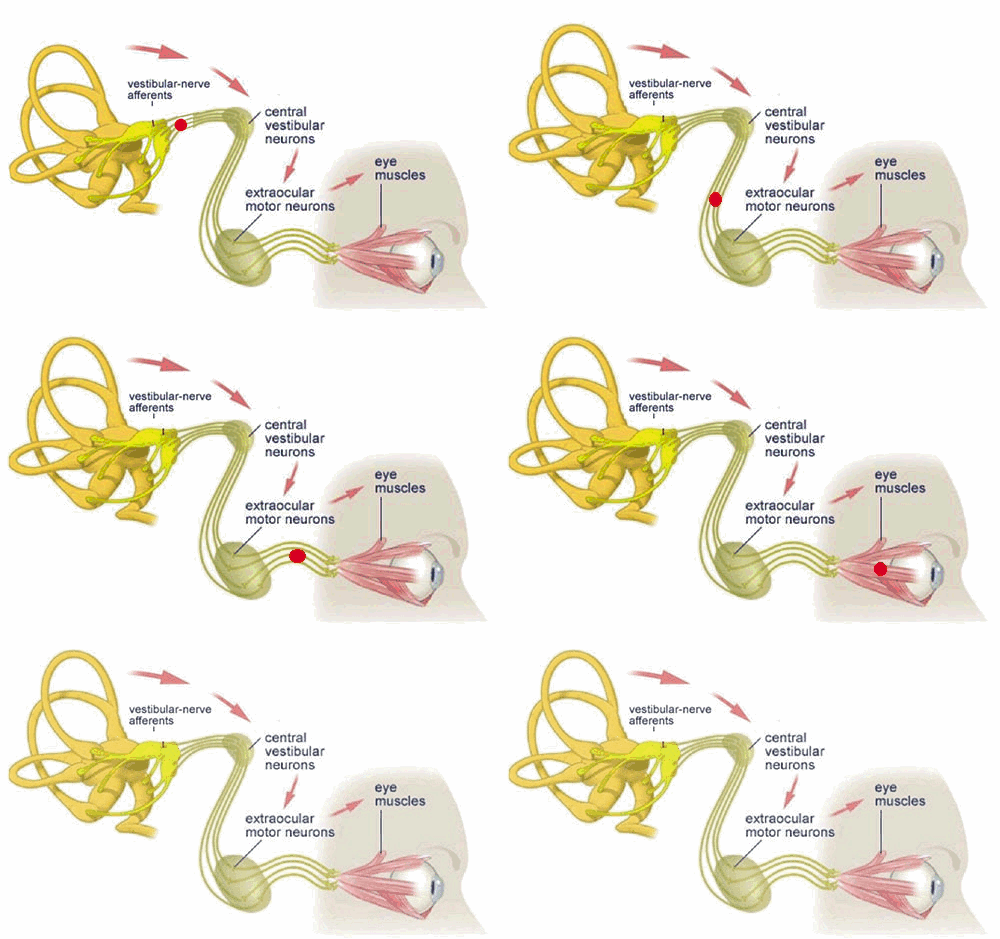


And in turn...

'Sensory receptors in the eyes provide important feedback regarding orientation of the body in space. In other words, where is the head in relation to the horizon? As discussed in Chapters 5 through 7, dysfunction in the visual perception of “straight ahead,” common following brain injury, can cause dizziness, disorientation, and imbalance. In the process of orientation, visual input also provides information regarding possible environmental hazards, barriers or avenues of escape. In the presence of impaired inputs from either the somatosensory (sensory projections from all over the body) or vestibular or both systems there is a strong dependence upon visual input. Defective input from one of the three systems (visual, proprioception/somatosensory, vestibular) may be compensated for by the remaining intact systems such that the patient is able to function, albeit with some discomfort and loss of efficiency. However, dysfunction in two of the three systems will result in significant disability.' - Vision Rehabilitation

Problems?

Even though the vestibular sense might often be overlooked by physicians, one will be made aware of its existence in case of dysfunction.

- Inappropriate nystagmus
'Spontaneous nystagmus, occurring when the head is static (still), is an indicator of acute peripheral vestibular loss. Nystagmus is often along the horizontal plane. Vertical or torsional spontaneous nystagmus usually indicates a direct injury to the brainstem. The cause of this inappropriate nystagmus is a direction-specific imbalance in the VOR as brainstem neuronal circuitry is activated. Inappropriate nystagmus may also be related to medication toxicity, such as some antiseizure medications.' - Vision Rehabilitation

Inappropriate nystagmus may also be provoked by head shaking and indicates an imbalance of dynamic vestibular function.

An indicator of inappropriate nystagmus of central origin, caused by brain dysfunction rather than dysfunction of the peripheral organ, is often the inability to inhibit nystagmus with visual fixation.


- Dizziness
Feeling disoriented, especially in dark areas, or feeling spacey, floating, rocking, or lightheaded. Dizziness is not always related to vestibular dysfunction but may indicate non-vestibular causes, one of which being visual disorders. However, when dizziness is mentioned, involvement of a vestibular dysfunction must be considered.

- Vertigo
Even though dizziness and vertigo are often used interchangeably, technically there is a difference. Vertigo refers to the illusion of movement, typically rotational, when no actual movement is observed. True vertigo refers to vestibular system involvement.

- Motion sickness
What causes motion sickness?

'There is a hierarchical preference to rely on visual input more than any one of the other two systems (vestibular, proprioception) involved in balance. Vision, as proposed by Bronstein, had a dominant role or “hierarchical preference” over proprioceptive input in the process of maintaining upright posture and balance. However, Mallinson et al. suggested that a “visual preference strategy” would not apply to some individuals who have an intolerance for any disagreement between visual and vestibular signals. Paige had previously called this disagreement between the two systems as a “visual vestibular mismatch” (VVM) and others referred to it as a “sensory conflict.” By 1996, the “sensory conflict” theory for the development of motion sickness had been accepted within the scientific field studying this subject.' - Vision Rehabilitation

- And more...
Balance problems, gait ataxia, ...

Of the top of my head I can think of two interesting cases I read about involving vestibular dysfunction.

In the book 'The brain that changes itself', Norman Doidge described a woman who felt like she was perpetually falling due to vestibular injury.   Her vestibular organ was damaged but her central vestibular processing capabilities were intact. We can't even start to imagine how she felt. It completely ruined her life. Until a certain Doctor thought of the idea to supply her brain with 'vestibular input' in a different way. He connected an accelerometer to a tongue outlet which gave her a certain signal depending on the direction towards she was falling. Through the mechanisms of brain plasticity she learned to ignore her vestibular organ and to stabilize herself using this new input stream. Somehow over time, as her brain re-calibrated, she became less dependent on the device and needed it less and less.

Another vestibular story was featured in Oliver Sacks' 'The man who mistook his wife for a hat'. A Parkinsonian, 93 year old, retired carpenter whose vestibular sense had become more and more unreliable started walking tilted over to one side without knowing it. His senses deceived him until he saw himself on camera. He was speechless. After this discovery he wondered whether he could apply the mechanism of a spirit level to his problem. He designed a pair of glasses including some sort of spirit level which he could then use to teach himself to walk upright again. Essentially he retrained his impaired vestibular system using visual feedback. At first it took a lot of conscious effort but later on it got easier and easier. Just like learning how to drive a car.

Psychological impact of vestibular dysfunction

'There are a variety of reasons why patients suffering from episodes of vertigo develop anxiety, depression, poor self-esteem, and a growing sense of disability. The fear of falling or the fear of heights is common. Concern for a sudden onset of vertigo and the loss of control in public venues often leads to avoidance behaviors or “safety-seeking behaviors,” as coined by Gurr and Moffat. The appearance of staggering, falling, and confusion may lead observers to believe that the person is intoxicated. The patient soon finds him/herself avoiding social events and staying home to avoid embarrassment. Physical activity is avoided for fear of provoking an episode.' - Vision Rehabilitation


Testing

- Static and dynamic balance testing. Dynamic balance tests require input from the Vestibulo-Ocular Reflex to stabilize the visual field and make rapid adjustments in posture. Dynamic gait, sit-to-stand, ...
Dix Hallpike maneuver
- Bithermal Caloric irrigation test (COWS): spraying water in the ear. Check it out on Youtube. It's pretty cool.
- Comprehensive Vision Testing: gaze, tracking, binocular vision, perceptual, functional, nystagmography, ...

Please read Chapter 9 of 'Vision Rehabilitation' for more detailed information. 

Rehabilitiation of the vestibular system

Vestibular injury or dysfunction can impose dramatic alterations in a patient’s once active lifestyle. There will be occasions when medication can be helpful in the short term. Surgery is the rare choice. Therapists take caution when a patient has other disabilities (brain trauma, stroke, peripheral neuropathy, spinal conditions, and/or vision disorders), which may limit choices of exercises.

'A key factor in achieving the best outcome will be patient compliance. Education is the greatest tool used by a good therapist to engage a patient’s willing participation in what is usually a difficult treatment program. Between, both, the vestibular therapist and the psychotherapist the patient is assisted in understanding the basics of the dysfunction: Why symptoms occur; the emotional response; and how treatment should help. Initial treatment typically provokes unpleasant symptoms but feeling worse comes before feeling better. Another factor in achieving the best outcome involves adequate intensity and duration of the treatment program.

Progression of function is the best gauge for the effectiveness of treatment. The process of treatment involves strategies for adaptation and substitution by using other strategies, habituation (desensitization), and retraining of balance. As the patient is able, exercises are expanded to include cardiorespiratory conditioning. Goals of vestibular rehabilitation are to (1) optimize compensation in the balance system; (2) habituate abnormal vestibular responses to rapid movements; (3) reduce fall risks by improving balance and postural control; and (4) educate the patient.' - Vision Rehabilitation

Is it a vision problem or vestibular problem?

It's important to figure out whether you are suffering from a vestibular problem with a visual component or a vision problem with a vestibular component. For strabismics who identify with some of these issues, the answer is probably 'a vision problem with a vestibular component'.

That is why in the more advanced stages of Vision Therapy you are not only training eye movement. You are to stimulate your way towards overall sensory and thus vestibulo-visual integration. There's a million ways to skin that cat. Some of the things I do as vision therapy loading: walking, head turns while attempting to keep my gaze stable, walking a beam with yoked prisms, balance board, jumping on a trampoline, standing on my head, running, ...

When my vision tends to go blurry or double and I feel dizzy, it's time to take a break. I flirt with my limit, take sufficient rest and remind myself that sometimes you do have to feel worse before feeling better. Improving these elementary vestibulo-ocular skills does influence and improve more sophisticated and more cognitively taxing ocular motor activities such as reading. The ground is being prepared!

Sunday, July 27, 2014

Strabismus, visual field loss and visual-spatial neglect


"Right after I lost vision in my eye, I was so bad at walking that I ran into a girl eating ice cream, and knocked her cone out of her hand. She screamed: ‘Are you blind!?!?’ I turned to her and said: ‘I am blind actually, I’m so sorry, I’ll buy you a new cone.’ And she said: ‘Oh my God! I’m so sorry! Don’t worry! It’s no problem at all! I’ll buy another one.’ So we walked into the ice cream store together, and the clerk said: ‘I heard the whole thing. Ice cream is free.’"

This little charming story by 'Humans of New York' reminded me of the many times I have bumped into people and objects on my left side. For instance, as a kid I was frequently punished for accidently breaking things or 'not behaving'. As a teenager I remember one incident that occurred while I was trying to navigate a busy street. By mistake I bumped into a young woman with my shoulder without bad intentions, immediately apologizing. I quickly left the scene before her Alfa-male boyfriend was ready to punch me. Ha!

On another occasion I quite simply hit the metal detector at the airport with my left side while trying to walk through it. Apparently regulations state that anyone walking onto the detector has to be frisked in any case. Another pleasant left side neglect experience!

Even now, having much less suppression of my left eye, having a wider visual field and being relatively more binocular and bilateral, I frequently bump into objects on my left side. Just yesterday I hit a door post with my shoulder while running into a room. Ouchie.

Fortunately, as it happens, I just read the 'Evaluation and Treatment of Visual Field Loss and Visual-Spatial Neglect' chapter of the book 'Vision Rehabilitation'! Just when I thought I had read all about my life in the Spatial Vision (!) chapter, or at least about what has been missing from it, those vision nerd authors pulled me back in! -------- (Expect a book review, people. Expect it!)

Visual field loss

The most known causes for visual field loss are eye disease (see picture) or damage of some sort to one or both of the eyes. This is the case for the gentleman featured above.


 Often, however, visual field loss can present more subtly on a cortical level. Cortical vision loss can occur developmentally or due to various kinds of brain injury. Whatever the cause of the visual field loss, the symptoms and the suffering associated are similar. Because of the complexity of the brain, cortical vision loss is very personal and presents itself differently in each patient.

This image gives you an idea of how various cortical disturbances can lead to
different types of visual field loss 
Measurements of visual field loss are performed following the quadrant schematic. I’m not going to get into all the possible types of vision loss but it is important to know that various types of visual training, sometimes including the use of prisms, are available to improve visual brain function. Even when it is impossible to recover vision in a certain field, training can systematically improve adaptation by optimizing residual abilities. Relearned environment scanning can avoid future accidents, elevate quality of life and increase independence.

One very interesting aspect about visual field loss is that some patients lose conscious awareness of what is seen in a field due to damage to the primary visual pathway or the visual cortex but can still intercept valuable visual information through unconscious visual processing. This is called blindsight. In case of blind sight a partially blind patient might be able to perform saccading or pointing to an object in the blind field, be able to use information from the blind field to better execute perceptual tasks in the intact field or even be able to ‘guess’ features of an object in the blind field at much higher rates than chance. There is indeed a neurological basis for these peculiar skills. Even more interesting for the cause of vision rehabilitation is that these latent abilities can be trained to eg. improve maneuvering. --- Also check out this video on blindsight

Visual-spatial neglect

Many patients with visual field loss are aware of the fact that they have lost vision in a certain field yet some aren’t. That’s where things get even more tricky. Some patients with visual-spatial neglect are in some sort of ‘denial’ about their missing visual field. It simply doesn’t exist in their mind. People with visual-spatial neglect think they have an accurate representation of their environment and don’t really feel the need to compensate for their visual deficit. This too can present in a number of degrees. There’s personal, peripersonal or extrapersonal neglect. People with personal neglect do not only ignore half of their visual space but also ignore half of their own body image to a greater or lesser extent. Peripersonal neglect indicates the neglect of space within arm’s reach and extrapersonal neglect adds the neglect of space beyond arm’s reach.

The presence of moderate to severe visual-spatial neglect can disrupt a variety of daily activities such as dressing, eating, reading, writing, walking, returning to work, and driving. Patients with left visual-spatial neglect will typically veer to the left when walking or bump their left shoulder on the doorframe. (BINGO) -- Vision Rehabilitation

Since most eye doctors aren’t even capable of detecting or treating any brain based vision dysfunctions which are often literally staring them in the face, it is no surprise visual-spatial neglect often goes undetected. In my case bumping my shoulder and what seem minor mishaps were less worrisome to me than, say, double vision. Nonetheless, many with more severe visual-spatial neglect, but without associated motor deficits, go undiagnosed and untreated following stroke or TBI.

They may be misdiagnosed as having dementia, as family and caretakers are unable to understand why a person might end up with their pants on backward (when they put them on, they only acknowledged one leg, so there was no frontward or backward choice), or why they forget to finish a task or put away tools. It is not always as easy as noticing that they do not finish food on one side of their plate. Patients with visual-spatial neglect are frequently misdiagnosed as having visual field deficits by vision care practitioners who are unaware of the possible diagnosis or visual-spatial neglect. -- Vision Rehabilitation

Indeed, it is not always easy to determine whether a patient has visual field loss, visual-spatial neglect or both! That’s why appropriate testing has to be done in order to get answers to those questions and get appropriate treatment.

Visual field loss and visual-spatial neglect in strabismic and amblyopic patients


As for the connection between strabismus, visual field loss and visual-spatial neglect, it is clear there must be a considerable incidence of neglect among strabismics. Suppression of part of the visual field to deal with misaligned eyes can be seen as self-induced visual field loss. This suppression of one of the eyes, be it permanently or alternately, leads to a reduced field of vision. In my case it is no surprise I bump into doors with my left shoulder as my left eye was traditionally the ‘lazy’ one. Even now with a field of vision that is as binocular as ever, I still tend to suppress peripheral vision coming from my left eye in more stressful situations requiring focus. Clearly this also affects my body image as I seem to be less likely to take into account the existence of my left side while moving.

The most common location for the lesion causing left spatial inattention is thought to be the right parietal lobe. In most patients, corresponding lesion to the left parietal lobe causes mild or transient visual-spatial neglect of the right space. It has been hypothesized that the right hemisphere modulates attention to both hemi-fields, where the left hemisphere modulates attention mainly to the right hemi-field only. Thus, damage to the left parietal lobe may cause an imbalance in allocation of attention from the pre-injury state, but damage to the right parietal lobe, common in middle cerebral artery infarct or aneurysm, causes marked visual-spatial neglect, as this is the major cortical substrate for orienting and allocating selective attention to the left hemifield. (!) In very young children, this hemispheric dominance for spatial attention is not yet fully developed (!) as evidenced by line-bisection tasks at age 4-5 years (!). Children show adult-like bisection with a slight leftward bias in bisection by 7-8 years of age. -- Vision Rehabilitation

That solves the mystery then. At the age of three my bispherical development went array and I developed amblyopia, strabismus and visual-spatial neglect. In addition to the distorted body map and frequently missing visual fields, unreliable alignment of the visual axes produces conflicting input to answer the basic ‘where am I?’ and ‘where is it?’ questions. Answering those two questions are the two primary objectives of the visual system preceding the ‘What is it?’ and the ‘What to do about it?’ questions. In developmental strabismus, neglect might in fact be a way of dealing with these conflicting inputs. To resolve the conflict one side has to foot the bill. That’s why, at this point in my rehabilitation, I am putting a lot of emphasis on not only aligning the eyes but also paying attention to my entire visual field and doing activities that promote bilateralism. Again it seems to come down to the magic three: the integration of visual input, vestibular input (balance) and proprioceptive input (self awareness and body image).

I'll try to be more practical about what I actually DO to integrate those types of sensory input next time. :)


Sunday, April 27, 2014

Head rotations, bar reading and bring on the prism flippers

Head rotations
Last week, for the first time, I had a completely stable percept while doing my head turns. I couldn't believe it!  I thought I was suppressing or something but I wasn't. Both eyes were just heedlessly adjusting to the head movements without error. It must be great to be able to take these reflexes for granted! I had predicted this milestone for the end of April et voila. Another hurdle taken. The reflexes are not equally reliable every day but that, again, is a matter of time.

Speaking of head turns... I'm reading this awesome book called 'Vision Rehabilitation: Multidisciplinary care of the patient following brain injury' which I will review properly later on. It had some interesting things to say about the anatomy of vision and head rotations.

The cortical or supranuclear influence on gaze is carried out by six distinct neural networks: (1) the saccadic eye system directs the fovea from one object to another object of interest; (2) smooth pursuits hold the image of a moving target on the fovea; (3) the vergence system acts to move the eyes in opposite directions (i.e., convergent and divergent) so that the image of a single object in space can be placed simultaneously on the fovea; (4) vestibulo-ocular holds images still on the retina during brief head movements driven by signals of the vestibular system; (5) optokinetic system holds the image still insofar as possible during sustained head rotation or watching a sustained stimulus going by, such as a train; and finally (6) the fixation system holds the fovea in place on a stationary target. These complex supranuclear networks result in eye movements coordinating whole muscle groups. With the exception of the vergence system, supranuclear eye networks mediate conjugate eye movements. Thus, other than vergence system disorders, supranuclear damage does not lead to diplopia, but to restrictions of conjugate gaze, as in loss of upgaze or downgaze.

Misalignment of the two visual axes with complaints of diplopia frequently results with lesions involving the infranuclear portion of the gaze system, including Cranial Nerve III, IV, or VI or the myoneural junction or extraocular muscles they innervate. Intranuclear lesions also result in diplopia. Innervation of extraocular muscles is ipsilateral to the CN nucleus for CN III and VI, and contralateral for CN IV. The infranuclear ocular motor system is a complex motor system requiring the coordination of twelve muscles to move the eyes.

So there you have it then... I've got problems with the supranuclear, ifranuclear and intranclear portions of the gaze system but the head rotations are on their way! :D In my case it was not a traumatic head injury but a combination of uncorrected developmental weakness and bad surgical intervention. The result for the visual system however is the same. I remember a number of ophthalmologists/strabologists giving me some spiel about third cranial nerve palsy 'with unknown cause'. Yeah, sure mate... Unknown cause. After the surgery there was not only horizontal misalignment but also vertical misalignment meaning the stress on that nerve had increased because the muscles had become so much harder to operate. Vertical alignment also meant that now CN IV had become affected. Overall visual stress on the visual system had become too much to bare as some parts of the system had been ignored and neglected whereas other parts had been damaged in surgery.


Bar reading
I'm a bit repetitive in my mentioning bar reading. I just love this exercise. Nowadays I just wake up, eat something and spend an hour or so bar reading until I get tired. Not completely exhausted though. Up until the point that I still got some juice left but it's time to go for some less visually stressful activities as the day progresses. The hardest part about bar reading is to stop and wait until the next day so I can do it all over again. That's just because I love reading too. I've gone from zero pages at the beginning of this year to 14 to 15 pages a day by the end of April. Hopefully things keep progressing at this pace. It's much more fun to read properly and binocularly than to read in a half assed way. The bars keep you tied up in a 'binocular straight jacket' preventing you from falling back to double vision and visual confusion. Reading while experiencing double vision and visual confusion feels like you are hurting yourself and giving yourself a headache on purpose. I've done this many times to study the things I needed to know to survive but it's not the way to live your life in the long haul. When my bar reading juice is up for the day, I resort to text to speech software, audiobooks or other normal day activities which can include less cognitively taxing forms of visual exercise.


Bring on the prism flippers
To enhance the bar reading progress and the elimination of my remaining convergence insufficiency I'm going to start using prism flippers by the end of May. Making it a little harder yet again. Going to the next level. The new normal.