Showing posts with label vision training. Show all posts

Sunday, March 29, 2015

Cheiroscope: video, drawing samples and implications

After a nice theoretical post, let's get down to the nitty gritty. How can we get a tangible look into how someone perceives his personal space? How can we determine inconsistent perception of space interfering with the construction of solid brain maps?

As vision writes spatial equations for the muscles to solve, cheiroscopic drawing is an interesting way to gauge the state of ocular motor ability and spatial vision. During cheiroscopic drawing, one's visual system is completely stripped of contextual aids. Broader context often helps strabismics to get around and complete certain tasks by circumventing proper ocular motor movement or spatial vision and by relying on sub-optimal, monocular vision adaptations and other senses. When using a cheiroscope none of that is possible. Your drawing hand and fingers HAS to take its cues from the eyes. The movements of the hand are based on the movements of the eye. If the eyes are positioned well, move together in a smooth and harmonious manner and can maintain a steady posture, you will succeed. If not, you will come up with an inconsistent and skewed drawing. It's that simple. A direct connection. No more adaptations, no more tricks, nowhere to hide from your visual shortcomings. It's a head-on confrontation with your visual limitations but also an opportunity to improve and to chart and compare that improvement over time.

I made a little, informative video about a cheiroscope that can be used at home. I apologize in advance for the constant movement of the camera. My video recording skills also need more work!


Here are some more of my practice run results produced by using that device (March, 2015). They are each of them unique and contain small mistakes. The variations in the drawings are variations in my vision and ocular stability. My vision is still volatile and unstable. Yet, it's a far cry from where I've come from years ago. This maze is very detailed and requires a fairly sophisticated level of ocular control on which to base your solution. Merely being able to try this exercise is already a triumph for me.


Let me show you where I've come from, going all the way back to February, 2011. For that purpose, I will be showing drawings made by me with another type of cheiroscope. This is a standup variation of the cheiroscope. It is called the Wolff cheiroscope named after Bruce Wolff, OD, who designed it.

Recently, at the VT office, we were comparing some cheiroscopic drawings I had made over the years. These pictures compare the results of the same cheiroscopic drawing exercise. The upper drawing was done on October 16th, 2012. The lower drawing was done on March 16th, 2015.


The relative position of the drawings is different because of different eye positioning. Also the quality of the drawing itself is markedly different because of improved ocular stability. In 2012 the left hand drawing was so inconsistent that the sun wasn't even staying her box. Hell, there was not even a clear box! And, as someone acutely pointed out, now the suns do have a smiley face!

What's even more startling is the fact that, on October 16th, 2012, I had already been in Vision Therapy for one year and eight months! Here are two cheiroscopic "Van Orden Star" drawings comparing February, 2011 to October 16th, 2012. The drawn lines should converge onto the highlighted fold. In the first drawing, in 2011, this certainly wasn't the case. I had a considerable vertical misalignment too.

Van Orden Star
Notice that, in the picture with the sun drawings, the upper drawing was drawn on the same day as the lower Van Orden Star drawing. This nicely demonstrates that improvement is relative. On October 16th, 2012, I was delighted about my improvements regarding the "Van Orden Star" drawing. However, the more visually demanding and detailed sun drawing exercise left much to desire. Now, another two years later, the sun drawing too have improved significantly and I will continue to go down this road of more ocular stamina and accuracy. The only thing one can do is to consider his current vision status and keep on stacking incremental improvements to eventually get to a better place in the future.

My primary vision therapy goal is not stereo vision. Stereo vision seems to be a combination of various basic vision skills. Overcoming the crippling legacy of strabismus surgery, which has thoroughly destroyed already ailing basic vision skills, is my primary vision therapy goal. To be specific, I need smooth tracking, reliable saccades and a stable vestibulo-ocular reflex. When I accomplish that, I'm golden. From what I hear, stereo vision will be a nice bonus on top of having these basic visual skills. These basic visual skills by themselves are pretty awesome too though! Without eye muscle surgery, I would already be seeing in stereo! However, as the cards have been dealt this way, these extra hurdles have to be taken. There is no other way.

Me and my Vision Trainer summarized the current situation as follows. "No one would have thought you would have come this far when you walked through the door, more than four years ago, but now you possess the basic visual skills. You can see through both eyes, you start having fairly good eye motility, you have some fusion in polarized targets and you can even figure out depth in tranaglyphs with a reference object like your finger or a stick! You have all the ingredients and now have to go a little furter and combine them into a good menu." 

The only missing ingredient is more time and work. I can do that. The cloak of subdued dysfunction is slowly lifting itself. I have mentally prepared myself it might take until January 2017 for me to reach workable levels of vision. After six years, I think, this Vision Therapy thing will start to lose some of its charm. Hahaha. Cheers, everyone!

Saturday, January 24, 2015

"Electronic Rapid Alternate Occlusion Goggles" as Anti-Suppression treatment

Following an interesting thread on Facebook and some e-mailing back and forth with Patricia Simone Fink OD and Eric Hussey OD who were generous enough to share their time, research and experience with me, I decided to make another investment in my vision in the form of Electronic Rapid Alternation Occlusion Goggles. New year, new projects and new ways of approaching existing problems!

What are Electronic Rapid Alternate Occlusion Goggles?

"Electronic rapid alternate occlusion (ERAO) using liquid crystal lenses is used to treat suppression of binocular vision, a defect affecting the sensory combination of two eyes’ images into actual binocularity; that is, simultaneous two-eyed, bi-foveal vision. Suppression remains a primary focus of the investigation of visual sensation in strabismus and amblyopia. However, abnormal binocular sensation in the form of suppression also occurs in the absence of strabismus and amblyopia as intermittent central suppression (ICS). As the name implies, intermittent central suppression is a repetitive on-and-off form of loss of central visual sensation. Active therapies for suppression, and ICS in particular, almost always involve two components: a bilateral (bi-optic) visual environment (e.g., a stereoscope) and visual motion."

Demonstration videos

By Eric Hussey OD


Idea and research

Without stealing too much of Eric Hussey's spotlight I want to explain some of the ideas behind the treatment.

In his study 'Remote treatment of intermittent central suppressionimproves quality-of-life measures' Dr Hussey extensively tests this type of goggles on young adult students at Job Corps with significant reading difficulties due to diagnosed intermittent central suppression. These are students without strabismus or severe amblyopia but have lapses of interrupted binocular vision disrupting their reading abilities.

Why does this type of intermittant suppression happen? Traditionally suppression was thought of as a cortical inhibitory process all the way back at the visual cortex. Hussey, however, proposes that suppression is not solely contributable to inhibition at the cortical level. He suggests that suppression is the result of lack of development or disruption of the motion (magnocellular) neural pathway. This lack of development in the early stages of the visual process results in a lack of binocular integration further down the line, notably at the visual and extrastriate areas of the cortex.

"As an alternative to the cortical inhibitory explanation, Iʼve suggested that motion is the “on-switch for seeing” and that ICS (Intermittant Central Suppression) is a deficiency in the motion pathwayʼs ability to keep the image alive. Lack of motion signal lets the visual sensation drop out through the same mechanism as Troxlerʼs Perceptual Fading. That would explain why anti-suppression therapies revolve around visual motion in a bilateral field. Since Troxlerʼs probably happens at or near the Lateral Geniculate Nucleus, viewing that visual drop-out in the context of developing visual neurology in an infant might well explain some of the cortical changes in strabismus and amblyopia. Defect at a neurologically lower area will affect development of neurology in higher areas. This differs from the more top-down conventional wisdom summed up in the word Bielschowsky used to explain strabismic suppression: Diplopiaphobia. ... Merrill Allen theorized that a 9 Hz alternation rate made use of the Bartley Phenomenon brightness enhancement, in this view representing an improved visual signal at the cortex." - From the User Document accompanying the goggles

This principle is further elaborated in Eric Hussey's paper 'Is Anti-Suppression the quest for visibility' which will be published in the journal of Optometry & Visual Performance in the near future.

So if in cases of Intermittant Central Suppression inhibition at the visual cortex is not the main problem but rather an underdeveloped primary visual motion pathway, treatment should be targeted accordingly. Motion should be used stimulating this pathway and consequently encouraging more solid binocular vision.

"This does mean Iʼm suggesting suppression is a primary visual problem that is a result of lack of development of the motion (magnocellular) neural pathway. Developmental, yes, although Iʼve documented whiplash-produced ICS in an adult who did not show a suppression prior to the trauma. I suspect suppression and ICS in particular is not a simple function of stress. Development and/or trauma are involved. Thatʼs why we treat it with therapy and why lenses do not eliminate suppression. Lenses may reduce fatigue, fatigue may make ICS more evident, and therefore lenses may increase reading time before sensory meltdown, but lens application doesnʼt eliminate suppression." - From the User Document accompanying the goggles

In short when using Rapid Alternate Occlusion while doing a binocular activity these goggles provide a constant motion stimulus, even if put on a frequency at which motion is no longer consciously perceived. Frequent use wakes up this underdeveloped motion pathway, increases binocular viewing time and gradually 'glues' the eyes together. To learn about the consequent improvements in reading ability in students undergoing the treatment, which are above those of control groups and not attributable to any other factors, you should take the time to read the 'Remote treatment of intermittent central suppression improves quality-of-life measures' study.


Other ways this device may influence binocular vision (according to me)!

Vision is as much about retinal information (the visual stream) as it is about extra-retinal information (proprioception and efference copy). If you don't understand some of those words, that's alright.

As mentioned above, the goggles stimulate the visual motion perception pathway by the constant motion of the rapid on off alternation and thus a constant change in retinal input. That is the grunt work of anti-suppression, as Eric calls it, and should ultimately 'glue' the eyes together.

Rapid Alternate Occlusion might also influence the interplay of retinal and extra-retinal information. During the brief period of occlusion your brain doesn't have a visual reference of where your eyes are pointing, forcing your visual system to rely on other mechanisms like proprioception to keep its gaze steady and avoid uncontroled retinal slippage. If during occlusion the visual system relies too much on (absent) retinal information to stabilize gaze, and too little on extra-retinal information, one or both of the eyes will start drifting. Uncontroled retinal slippage is what sometimes happens to me while using the goggles because the proprioception and control of the muscles surrounding my eyes (extra-ocular muscles) has been significantly impaired through strabismus surgery.

Therefore, another effect of these goggles then is that they constantly force the visual system to re-evaluate itself and stay busy relying on different neural information to accomplish gaze stability. This too will improve visual stamina! As it forces the visual motion pathway to stay active and develop itself more fully, it also forces these two types of neural input to integrate more fully to deal with the visual challenge imposed by the goggles.

How I currently use it 

I have a visual history of alternating strabismus with pretty good eye sight in both eyes. I have experienced constant double vision for a couple of years. Nowadays my eye alignment has improved to the point that I have aligned eyes most of the time. Traditionally I used to be a esotrope but after surgery my strabismus became non-committant with a tendency towards exotropia. Right now I still have Convergence Insufficiency and intermittant suppression in certain fields of vision resulting in a lack of real binocular fusion.

I'm pretty confident as far as further ocular motility improvements go. I can eliminate the Convergence Insufficiency by continuing my visually conscious lifestyle. It's also important to realize that these are not separate issues. If Convergence Insufficiency disrupts eye alignment for near tasks, there is no fusion. If there is no binocular fusion, eyes have a tendency to wander.

With these goggles I hope to continue and accelerate the 'grunt work' of anti-suppression. It will do so by means of a combination of the retinal and extra-retinal information mechanisms described above.

I use it every day while doing not so spectacular tasks like watching TV, daily domestic activities (if it doesn't get in the way) or maybe some brief reading. I have yet to use it with a Cheiroscope as demonstrated in the video next time I go for VT. It does feel intense and the increased visual load tires you. Unsurprisingly it also tires people without a history of binocular problems. Go figure.

I have been instructed to use it 40 to 50 minutes a day, 5 to 7 days a week. If that is too taxing, I should work up to it. That is what I am doing. I think I'm more or less at 20 minutes a day. I use it in periods of 5 to 10 minutes a time at a setting of 5Hz with equal 'open time' for both eyes as I am not severely amblyopic. As Eric puts it: "The hope would be that we literally improve/wake up the central visual sensation or central visual signal which means your brain should have the information necessary to glue your eyes together. With diligent use, I’d like to think that the end of the year might bring some improvement. Neurology is tough stuff, though."

Nevertheless, the theory makes sense and it feels visually intensive in various ways so I'm very curious about what the results of my experiment will be!

More information about another provider of Rapid Alternate Occlusion treatment and trails

http://www.eyetronix.com/

Thursday, December 25, 2014

Looking back at 2014 and looking forward to 2015

I just reread my post from December 25th, 2013. It's always interesting to compare thoughts over time. Often we get lost in the day to day to remember the overall progress we have made. I remember being able to do some bar reading for the first time ever in January 2014. I also remember being able to do head turns without the view going double and shaky in May. This still isn't always the case, depending on fatigue, but that's when it happened for the first time. Stabilizing the Vestibulo-Ocular Reflex will be of utmost importance to complete this visual rehab process. Two major milestones right there.

These firsts produced themselves under controled circumstances and while maintaining a regimen including lots of rest. They need to be solidified but they are obviously good signs. I still face trouble reading and using electronics due to convergence problems BUT there is improvement. Improvement is what we are going for. You can't expect to directly go from being partially paralized to running marathons. It feels like I'm litterally completing a picture and filling in the holes, motorically and perceptually. Each year, since I discovered Vision Therapy, I have added or improved underdeveloped or damaged visual skills and it's compiling into something substantial. I hope all these elements will come together, integrate and anchor themselves through sensory fusion and hopefully stereovision the upcoming year. In the end it will have been worth every second. As the years go by I feel less shell-shocked and post-traumatic stressy and more grounded and armed with more adequate visual artillery to face the world and its challenges. If I can pile another year of improvement on top of that, who knows where that will lead me. I'm eager to find out and pursue that road. Usually the results always produce themselves but the timeline is always more extended than I'd hoped for. God, give me patience! :) Happy New Year!


It might have to be the next Christmas, or the one after that,
but I will get what I'm after.

Wednesday, December 3, 2014

Check-up 9: Our four year anniversary

On December first I had my half yearly optometric evaluation. Sight in both eyes is good but the axis of astigmatism in my left eye has shifted marginally.

This is my current Rx.
OD: +2.50
OS: +2.50 cyl -1.0 axis 35°

When testing my binocular vision my ocular motor abilities are approximating what it should be. When testing sensory fusion things are less clear. Looking through an haploscope using some basic targets I do perceive the suppression controls and have what looks like a consistent and fused image. Based on this my optometrist tells me I have 'central and peripheral fusion'. I'm not so sure though. Using anaglyph (stereo)targets I do not perceive 'luster' fusion, rather I perceive constant switching between red and green. It seems hard to agree on a definition of fusion. But it is true that even though I might still have some form of intermittent and partial suppression at times, it is very easy to consciously break that suppression. Nonetheless it might still be too conscious a decision, especially while in motion. (More about the issue of unconscious intermittent and partial suppression and a potential solution in later blog posts).

In stereo targets, as seen through the haploscope, I can discern the correct relative distance between various elements of the picture by the way my eyes converge or diverge while viewing each of them in turn. When using polarized stereomaterials I do not directly perceive any 3D. To sum up, during none of the tests did I perceive any salient 3D but there are promising signs. "Certainly no bad news today.", the optometrist said.

Revised 'timeline' - Last surgery was in August 2009


The challenge as a chronically untreated young adult with strabismus would have been to overcome the neurological atrophy and the decay of my vision, both motorically as perceptually, as it unfolded ever since my visual development went array. Compared to the current undertaking, that would have been relatively easy. Not easy, but relatively easy. However, I (and my optometrist with me) would say that eighty percent of my recovery is about overcoming the abysmal results of the surgeries I have undergone as a young adult (ages 16, 18, 19) completely obliterating my academic and professional prospects. That is why I am about to enter my fifth year of Vision Therapy.

In order to add more perspective, I'd like to translate and paraphrase some of the conversation I had with him in Dutch.

MICHAEL:  "Let's forget I've been doing this for four years and I were to walk into your office for the very first time in my current condition. What would you tell me?"

G. NAEGELS: "I would tell you you have a slight exophoria and all physiological preconditions for stereopsis recovery are present. In view of the fact that you only developed strabismus at the age of three (accommodative strabismus) your recovery prospects back then would have been excellent. At that age it is very likely you have already SEEN in stereo up until the binocular disruption. I'd recommend for you to try and re-acquire stereo vision because it will greatly improve the quality and stability of your vision and life in general. I think it's within reach now. But it has to happen of course."

MICHAEL: "I'll have to make it happen then."

G. NAEGELS: "That being said, I still think that deontologically speaking I made the right call four years ago by telling you there was not much hope for recovery. Not every patient is as motivated and persistent as you are. I could not have foreseen that and I would not want to arouse expectations that can not be met by the optometrist alone. I've never seen someone so engaged in his recovery. I'm very happy to may have witnessed this in person. It's a pleasant surprise for me and it reaffirms what we are doing here."

MICHAEL: "Thanks. I have no other option so I act pragmatically. It's swim or drown. It's that simple. This HAS to work out."

Thursday, August 7, 2014

Some of my current home based VT activities

Everything we do or don't do has neurological consequences. That's why everything we do or don't do matters.

It's important to note that these activities are not suitable for every VT patient. Nor are they suitable at any stage in the rehabilitation process. They are suitable for me because my ability to control my eyes has reached a level allowing me to handle these activities without imploding, albeit with appropriate rest. Getting to this stage has taken a long time. I've had to do a lot of boring ground work first. Expanding the range of ocular movements, improving saccades, tracking and so on. VT is an active form of patience.

Another important reason of why these activities are appropriate for me as a VT patient is that my central suppression, especially while moving, is very poor. This means there is a very strong incentive for me to use both eyes and align them, rather than trying to suppress one eye. That's a very important point. Taking that into consideration, this means that I'm ALWAYS doing VT. I'm always trying to align my eyes and see binocularly because there's no alternative as there would be in a strabismic with good suppression. That's exhausting, particularly when trying to get out of an initial post-surgery double vision situation. Yet this might have some advantages at a later VT stage.

So what do I do outside the VT office?

1. Bar reading or, when more tired, listening to a text with TextAloud while tracking the words with my eyes. Even without suppression controls, I know when I'm doing it right when the text doesn't go double. The audio support while reading brings some relieve to my vision while still being able to practice saccades and integrate vision, audio and reading comprehension. Over time I feel like the saccades become easier and the audio support is less necessary. I'm gradually inserting prism and spherical flippers into the process to keep it challenging. So far however, (bar) reading hasn't been particularly easy yet.

2. Wearing a translucent filter on my glasses in order to stimulate my left eye and the neurology behind it. I do it in the morning when I'm relatively crisp. Initially doing this was a serious source of energy drainage. The filter in front of the 'good eye' makes the 'lazy' eye work harder in terms of acuity. It also forces me to acquire more dexterity relying on the more impaired eye. Lastly, there's a higher tendency for my eyes to go EXO with the filter requiring more of an alignment effort. To sum up: it works on acuity, eye motility and general integration of the eye into the nervous system.


3. When having to rest, meaning I just want to stare, I sometimes watch some kind of series or movie. When I'm up for it I use the flippers while watching. It's less tiresome than using them while reading because the eyes are more stationary. In fact, the spherical flippers help to relax my eyes when they are all tensed up. It's like stretching soar muscles.
When watching I also like to put a finger (or a remote) in front of my face. If I see two of them I am sure I'm not suppressing part of the view. (physiological diplopia)

4. Head turns. My Vestibulo-Ocular Reflex hasn't been working properly for a long time. This means that when my head moved, my eyes didn't make the appropriate compensatory movements to maintain a stable world view. This year (my 4th VT year) this has finally been leveling out and my eyes do make the appropriate movements for the world to stay fixed and stable. This new and highly anticipated skill isn't entirely reliable as it often gives way when I get tired. That's why I often check up on it and train it for short intervals by making head turns. My VOR needs further refinement, integration and staying power.

5. Anaglyphs: I play with these cards or other anaglyph visuals when I feel like it. Lately it's more fun because I can figure out the DEPTH in them by using my hand and physiological diplopia as a reference. It helps the learning process of corelating eye posture, image disparity and distance. The needed information is being picked up by my brain but I need to further automate these inferences. In the VT office we also use vectograms.


6. Lately I'm playing a lot of football (soccer), sometimes with the translucent filter in front of my left eye. Movement is good. Interaction with the environment is good. Messing around with a football is good visio-motor exercise. When my eyes stop aligning because of fatigue I notice two footballs and know it's time to call it a day.  It's important not only to get both eyes working together but also to integrate them into a moving body. I put special emphasis on using both feet and both sides of my body, mixing it up and trying to stay aware of the entire visual field and physiological diplopia. Football may not be for everyone but I have some very fond memories of playing football as a child so I try to tap into that. Positive emotions and enthusiasm are very important in terms of motivation and creating new pathways in the brain. 

7. Recently I had ten days of access to a trampoline. You'd think it doesn't really make that much of a difference but it does. When getting off the trampoline the world feels like it's moving beneath your feet. It's similar to disembarking a boat. Trampolines are great to further load and consolidate visio-motor and vestibulo-ocular skills. If that gets easy, you can further load the exercise with cognitive processing. Have a look at this cool exercise: http://www.oepf.org/sites/default/files/journals/jbo-volume-21-issue-3/21-3%20Slotnick.pdf 

8. Yoked prisms. These powerful prisms, used with bases to one side, shift your entire visual field to the direction of your choice. The lenses are adjustable. I use them bases up, down, left and right. By doing so I train internal adjustment to new visual circumstances. More specifically they stress test the brain's ability to ajust its egocentric localization, eye and body posture as well as sense of balance and spatial vision.  I have found them very useful in terms of aligning my subjectively perceived and objective midline which is often an issue in strabismus patients. Be careful with these toys though. Don't use them for more than 10 minutes at a time or you might suddenly get licked. They are effective but exhausting. I don't use them every day either. That said, I've had my most 'unusual' visual experiences after using yoked prisms.


9. Deck of cards exercise. It's similar to the 'classic' accommodative rock exercise. Get yourself two decks of cards. Tape one on the window, hold one in your hand and start scanning the window looking for corresponding cards. Emphasize accuracy, binocularity and physiological diplopia. Do it well rather than fast.


10. Taking walks. As for integration of the eyes into the body walking is perfect. Fast is easy, slow is hard. Running is not bad either but you might be paying less attention to the visuals and wasting a lot of energy that could be used for visual consolidation. Vision first, running later. That's how I see it. While walking, take care of your visual experience: eye alignment, physiological diplopia and just being aware of your body and the view. Don't just go walking around dull-minded with ear-buds. 

11. Being aware of my left side and using my left hand sometimes. As my left eye is my amblyopic eye, my right brain hemisphere needs fitness. This is almost surely a gross oversimplification but nonetheless trying to become more bilateral is part of becoming more binocular. Eg. if there's no time pressure I try to use my left hand. My mother told me that before I developed strabismus and amblyopia due to undetected farsightedness at age three, it was very hard for my kindergarden teachers or herself to tell whether I was left or right handed. I was just using either one. Then when I became strabismic the right side heavily dominated things visually and motorically. The chauvinist left hemisphere started hindering the development of my right hemisphere, visually and otherwise. Apparently, as I'm recovering, this is somewhat being reversed. Sometimes when I'm bored I doodle. Yesterday I was doodling with my left hand and noticed I could draw reasonably well with my left hand too. This is new!

Left hand drawing

12. Thump-Pinky Vergence Rock. An exercise similar to the Brock String. The best thing about this exercise is that it works on the integration of visual and proprioceptive input. This is often a decisive factor in getting ahead.  


13. Doing somersaults with my eyes open until I get dizzy. Usually three. That's another Vestibulo-Ocular Reflex integration exercise.

Obviously these activities are not exhaustive. There are many ways to combine and load activities according to your current level. I also don't do all of them every day. Rather, I try to make whatever I'm doing into a visual exercise. If you have some idea how a healthy visual system is supposed to work, you can aspire to that goal.  Just as important as what you do, is how you do it. In the end, life is just one big visual exercise!

Aside from exercising, I'm also eating a lot. It appears that I have already reached one of the goals I set for next year. In two to three months I've gained 6 kilograms bringing me up to 75kgs. This takes my BMI (height=1,85m) from 19.9 to 21.9.  I'd been trying to gain weight for a long time but I guess I'm finally calm enough for it to stick.
I'm mentally preparing myself for the fact that eliminating the residual Convergence Insufficiency and other visual instabilities up to a workable level will likely take another year to year and a half. With some luck and steady work I'll be an 80kg binocular machine by next year. That reminds me... I need to go eat something!

Sunday, July 27, 2014

Strabismus, visual field loss and visual-spatial neglect


"Right after I lost vision in my eye, I was so bad at walking that I ran into a girl eating ice cream, and knocked her cone out of her hand. She screamed: ‘Are you blind!?!?’ I turned to her and said: ‘I am blind actually, I’m so sorry, I’ll buy you a new cone.’ And she said: ‘Oh my God! I’m so sorry! Don’t worry! It’s no problem at all! I’ll buy another one.’ So we walked into the ice cream store together, and the clerk said: ‘I heard the whole thing. Ice cream is free.’"

This little charming story by 'Humans of New York' reminded me of the many times I have bumped into people and objects on my left side. For instance, as a kid I was frequently punished for accidently breaking things or 'not behaving'. As a teenager I remember one incident that occurred while I was trying to navigate a busy street. By mistake I bumped into a young woman with my shoulder without bad intentions, immediately apologizing. I quickly left the scene before her Alfa-male boyfriend was ready to punch me. Ha!

On another occasion I quite simply hit the metal detector at the airport with my left side while trying to walk through it. Apparently regulations state that anyone walking onto the detector has to be frisked in any case. Another pleasant left side neglect experience!

Even now, having much less suppression of my left eye, having a wider visual field and being relatively more binocular and bilateral, I frequently bump into objects on my left side. Just yesterday I hit a door post with my shoulder while running into a room. Ouchie.

Fortunately, as it happens, I just read the 'Evaluation and Treatment of Visual Field Loss and Visual-Spatial Neglect' chapter of the book 'Vision Rehabilitation'! Just when I thought I had read all about my life in the Spatial Vision (!) chapter, or at least about what has been missing from it, those vision nerd authors pulled me back in! -------- (Expect a book review, people. Expect it!)

Visual field loss

The most known causes for visual field loss are eye disease (see picture) or damage of some sort to one or both of the eyes. This is the case for the gentleman featured above.


 Often, however, visual field loss can present more subtly on a cortical level. Cortical vision loss can occur developmentally or due to various kinds of brain injury. Whatever the cause of the visual field loss, the symptoms and the suffering associated are similar. Because of the complexity of the brain, cortical vision loss is very personal and presents itself differently in each patient.

This image gives you an idea of how various cortical disturbances can lead to
different types of visual field loss 
Measurements of visual field loss are performed following the quadrant schematic. I’m not going to get into all the possible types of vision loss but it is important to know that various types of visual training, sometimes including the use of prisms, are available to improve visual brain function. Even when it is impossible to recover vision in a certain field, training can systematically improve adaptation by optimizing residual abilities. Relearned environment scanning can avoid future accidents, elevate quality of life and increase independence.

One very interesting aspect about visual field loss is that some patients lose conscious awareness of what is seen in a field due to damage to the primary visual pathway or the visual cortex but can still intercept valuable visual information through unconscious visual processing. This is called blindsight. In case of blind sight a partially blind patient might be able to perform saccading or pointing to an object in the blind field, be able to use information from the blind field to better execute perceptual tasks in the intact field or even be able to ‘guess’ features of an object in the blind field at much higher rates than chance. There is indeed a neurological basis for these peculiar skills. Even more interesting for the cause of vision rehabilitation is that these latent abilities can be trained to eg. improve maneuvering. --- Also check out this video on blindsight

Visual-spatial neglect

Many patients with visual field loss are aware of the fact that they have lost vision in a certain field yet some aren’t. That’s where things get even more tricky. Some patients with visual-spatial neglect are in some sort of ‘denial’ about their missing visual field. It simply doesn’t exist in their mind. People with visual-spatial neglect think they have an accurate representation of their environment and don’t really feel the need to compensate for their visual deficit. This too can present in a number of degrees. There’s personal, peripersonal or extrapersonal neglect. People with personal neglect do not only ignore half of their visual space but also ignore half of their own body image to a greater or lesser extent. Peripersonal neglect indicates the neglect of space within arm’s reach and extrapersonal neglect adds the neglect of space beyond arm’s reach.

The presence of moderate to severe visual-spatial neglect can disrupt a variety of daily activities such as dressing, eating, reading, writing, walking, returning to work, and driving. Patients with left visual-spatial neglect will typically veer to the left when walking or bump their left shoulder on the doorframe. (BINGO) -- Vision Rehabilitation

Since most eye doctors aren’t even capable of detecting or treating any brain based vision dysfunctions which are often literally staring them in the face, it is no surprise visual-spatial neglect often goes undetected. In my case bumping my shoulder and what seem minor mishaps were less worrisome to me than, say, double vision. Nonetheless, many with more severe visual-spatial neglect, but without associated motor deficits, go undiagnosed and untreated following stroke or TBI.

They may be misdiagnosed as having dementia, as family and caretakers are unable to understand why a person might end up with their pants on backward (when they put them on, they only acknowledged one leg, so there was no frontward or backward choice), or why they forget to finish a task or put away tools. It is not always as easy as noticing that they do not finish food on one side of their plate. Patients with visual-spatial neglect are frequently misdiagnosed as having visual field deficits by vision care practitioners who are unaware of the possible diagnosis or visual-spatial neglect. -- Vision Rehabilitation

Indeed, it is not always easy to determine whether a patient has visual field loss, visual-spatial neglect or both! That’s why appropriate testing has to be done in order to get answers to those questions and get appropriate treatment.

Visual field loss and visual-spatial neglect in strabismic and amblyopic patients


As for the connection between strabismus, visual field loss and visual-spatial neglect, it is clear there must be a considerable incidence of neglect among strabismics. Suppression of part of the visual field to deal with misaligned eyes can be seen as self-induced visual field loss. This suppression of one of the eyes, be it permanently or alternately, leads to a reduced field of vision. In my case it is no surprise I bump into doors with my left shoulder as my left eye was traditionally the ‘lazy’ one. Even now with a field of vision that is as binocular as ever, I still tend to suppress peripheral vision coming from my left eye in more stressful situations requiring focus. Clearly this also affects my body image as I seem to be less likely to take into account the existence of my left side while moving.

The most common location for the lesion causing left spatial inattention is thought to be the right parietal lobe. In most patients, corresponding lesion to the left parietal lobe causes mild or transient visual-spatial neglect of the right space. It has been hypothesized that the right hemisphere modulates attention to both hemi-fields, where the left hemisphere modulates attention mainly to the right hemi-field only. Thus, damage to the left parietal lobe may cause an imbalance in allocation of attention from the pre-injury state, but damage to the right parietal lobe, common in middle cerebral artery infarct or aneurysm, causes marked visual-spatial neglect, as this is the major cortical substrate for orienting and allocating selective attention to the left hemifield. (!) In very young children, this hemispheric dominance for spatial attention is not yet fully developed (!) as evidenced by line-bisection tasks at age 4-5 years (!). Children show adult-like bisection with a slight leftward bias in bisection by 7-8 years of age. -- Vision Rehabilitation

That solves the mystery then. At the age of three my bispherical development went array and I developed amblyopia, strabismus and visual-spatial neglect. In addition to the distorted body map and frequently missing visual fields, unreliable alignment of the visual axes produces conflicting input to answer the basic ‘where am I?’ and ‘where is it?’ questions. Answering those two questions are the two primary objectives of the visual system preceding the ‘What is it?’ and the ‘What to do about it?’ questions. In developmental strabismus, neglect might in fact be a way of dealing with these conflicting inputs. To resolve the conflict one side has to foot the bill. That’s why, at this point in my rehabilitation, I am putting a lot of emphasis on not only aligning the eyes but also paying attention to my entire visual field and doing activities that promote bilateralism. Again it seems to come down to the magic three: the integration of visual input, vestibular input (balance) and proprioceptive input (self awareness and body image).

I'll try to be more practical about what I actually DO to integrate those types of sensory input next time. :)


Tuesday, June 24, 2014

Football without stereoscopic depth perception (video + optometric analysis)

HISTORY

As a strabismic child that suppressed one eye at the time, I played football (soccer) during every recess period at school. Clearly I had no stereo vision. Nonetheless I was a fairly good player and loved playing. I could be totally absorbed by it. At one point I also tried playing in a club. Because of my vision dysfunction I didn't have the energy to both keep up with my school work and go to the training sessions so I had to quit. Suppressing one eye is a wasteful business. I had good reading comprehension but read very slow and have never been able to fluently read aloud. Just doing my homework was enough of a physical training.

Therefore my football practice stayed confined to school recess and lasted up until the age of 12-13. Past that age football was gradually reduced to the occasional game during mandatory gym classes in school. Still, I LOVED playing that sport. Nothing so exhilarating and relaxing as just going for it during a game of football. 

After the age of 13 school work increasingly started absorbing ridiculous amounts of time. When I developed double vision at the age of 18 and underwent the misplaced surgery, leisure sports went down the drain except for the occasional run. Double vision is not very practical when it comes to ball games, or anything else for that matter.

PRESENT

It's been a little over a year since my diplopia started to subside after 5 years of constant double vision.  However, it's only recently that  the increasingly accurate positioning of my eyes is starting to 'sink in'. A month ago, spurred on by the WC merchandise machine, I bought a cheap football in the supermarket thinking it'd be fun to do some oculo-motor 'cross-training'.

Have a look at what happened after a week or two after messing around daily for an hour or so. The video builds up towards the end and the last thirty seconds are pretty neat even though I say so myself.


Not bad in light of my history of strabismus (surgery) and the fact I don't even have stereo vision yet! Please allow me to explain why this is happening at this point in time.

"It is important to understand the many aspects of vision to be examined, and to gather quality data on each patient, as the visual system is a covert system, where the process and outcome are evidenced not as “visual”, but as motor or verbal outputs." - Vision Rehabilitation

As you might have noticed from previous blog entries, I've been putting a lot of work in refining my eye movements. By this I mean getting them to be more precise and consistent as opposed to spastic and erratic. In my case the first phase of strabismus rehabilitation can be described as overcoming oculo-motor restrictions/palsy. The way our eyes move might just be the most important part of seeing and most people don't even realize it. Depending on the strabismic patient and whether or not he had surgery this will take some time. However long it takes, it has to be done in order to progress to more advanced levels of binocular and visio-motor integration.

 I've NEVER been able to effectively juggle a football before, let alone 33 kicks without it touching the ground. The only reason why I can do this now, after years of not playing, is that I can keep both of my eyes focused on the ball. Even though I don't have full blown stereoscopic depth perception yet, my brain already makes these subtle trigonometry inferences about its position. That never happened before. The first 17 years of my life I was suppressing one eye, then I lived through a couple of years of double vision and now the eye alignment is starting to be incorporated at a cortical level. This is an aspect of binocular vision which is evidenced as motor output as I do not SEE any depth yet. Cool, right?

This was again confirmed in my VT session (#74) today. I had a 90 to 95% success rate deciphering the relative position of objects while viewing tranaglyphs and polarized vectograms by 'grasping them' in midair. It's unbelievable! I was just staring at my hands thinking 'magic hands'. Magic brain rather! This depth perception stuff is creeping up on me silently!

Finally my brain is slowly starting to make subconscious inferences about
depth based on the input and position of both eyes!
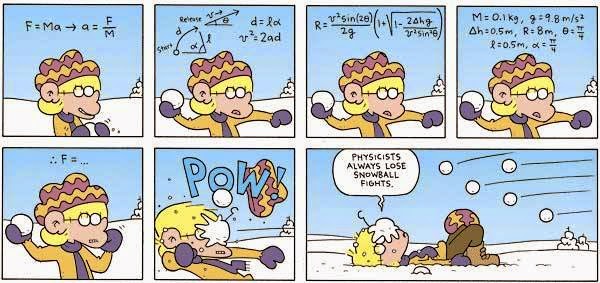
If your brain doesn't do that, you'll end up like this physicist.

IMAGE BY BILL AMEND
In light of that, these new found football skills make sense. The target is pretty large and it's a bit further than the distance range used for reading. Thus it requires less accuracy and less converging than reading. A nice stepping stool. This is good news as my optometrist said that this kind of motor feel for depth often precedes the actual seeing of depth.


FUTURE

My Dutch VT friend Yvette used to be horrible at catching things. This, to her own surprise, improved dramatically after working on her binocular vision skills for a year or two. She now says 'I can see the hole in the Frisbee and actually catch it'. When she, unrelated to her DIY VT efforts, enrolled for a course of slack-lining (walking a tightrope), one of the exercises was to catch things while keeping balance. 'Even though I was shaking like hell and did not find a stable balancing position, I was able to catch everything. Now I can also catch with my left hand, even without looking directly at the object.'

This is remarkable for a clumsy strabby who was never able to catch anything before! As she already acquired some stereovision, this is something to look forward to. Nevertheless, the benefits of stereovision are much broader than being able to catch stuff. From what I read, it's a whole different way of life. For now the punch line is that I'm making good progress and the best is yet to come. We ain't seen nothing yet!

Additional reading on vision, the brain and football
- http://www.axonpotential.com/teaching-your-brain-how-to-play-soccer/


If there are any football clubs out there wanting to sponsor my
strab rehab or you just like my blog... ;)


Wednesday, May 28, 2014

Session 72: In pursuit of more speed, accuracy and consistency

The foundation has been put in place. Finishing it up by perfecting the collaboration between vergence (eye movements) and accommodation (manipulation of the eye lens by your tiny muscles in the eye) and increasing capacity will be the closing deal. Major physical restrictions have been largely eliminated. More speed, more accuracy and more endurance. These will be the stakes as I move towards normal functionality. The time that I could not even participate in certain training activities has passed. Finally most activities are accessible and progress will, rather than being merely damage control and laying foundations, start to improve daily function and influence the way I can interact with my environment. Things are about to get extroverted instead of introverted.

“When vision is working well, it guides and leads; when it is not, it interferes.” - John Streff

The coming year we will go over that speed bump and make my vision guide and lead rather than interfere with my behavior. Right now my vision deficits still monopolize my life but I can feel and imagine how it will be as I gradually break through that 'visual firewall'.

Not only are all exercises accessible now but I'm making tangible, numerical progress at them and we can compare it to 'the standard values'. Before I also made numerical and tangible progress but it was still so subpar it sometimes seemed a Pyrrhic victory. At this time, I have entered the charts approaching normal function. This is totally new and makes it more fun. It's a game, not a tragedy. Three years and five months into the game I feel as optimistic as ever. Everything indicates a successful outcome and things keep moving into the right direction. When (eye) muscle tone, visual input and sense of balance will be synced up, I'm in for a major brain fart.

When testing my abilities on the biopter, both divergence and convergence, I could successfully execute up to slide 5 (out of 8), whereas last year I'd be stuck at slide 3. Well, pre-VT I'd be stuck at slide zero. :D

When playing with the vectograms today, which are supposed to bring out stereopsis if you already possess that skill, I was asked to 'grasp' the portrayed characters. If percieved correctly with the polarized glasses they would be floating midair. I don't see them floating at differing distances but when grasping for them my arm movement apparently more or less reflected the appropriate distance, or at least the right hierarchy.


*Spoiler alert* The king was closest, the monopoly guy furthest and the girl in between in terms of 3D distance, if I'm not mistaken. So there's that intuitive feeling telling me something based on my vergence movements I suspect. They are still too sloppy to be good, but we'll deal with that over the next year. Can't wait to put the cherry on that visual cake. I've been told Americans put cherries on everything. On top, on cakes, on your lips, in the fridge... Wherever you put it, I'll put it there.


Next time: "Standing on your head, yoked prisms and prism flippers".

Friday, March 14, 2014

Alternation, cyclopean eye and the attentional spotlight

As my eyes are aligned most of the time by now I have no real concept of alternating between both eyes anymore. Despite the mechanical alignment of my eyes, I still do not use them equally. My vision still seems to be rather lateralized to the right. When I intentionally give myself double vision by moving my eyes apart, the image from my right eye is still the 'main image' and the one from the left eye feels secondary. In fact, in double vision mode I can still alternate. I can switch main images and make the one from the right eye 'secondary'. So my subjective viewing perspective is not yet positioned in the middle of my head. My cyclopean eye is not positioned behind my nose. Most of the time I'm seeing the world from the right side of my head (subjectively, because this probably indicates there's a strong lateralization towards the left hemisphere). This means that even though my left eye nicely follows my right eye, it's still not an equal part of the team.

I'm doing a couple of things to actively work on that. As mentioned in previous entries I apply filters or transparent tape on my glasses to blur out vision in my dominant eye putting the left eye in charge. This changes the entire visual situation to the other extreme without entirely discouraging binocular eye teaming. I do this while doing all kinds of activities and it is effective in regaining and integrating the left eye into the visual system. But lately there's more... Aside from actively training, it is equally important in my experience to relax and just play with your perception. Often I lie or sit down and let my eyes wander around having things go double. Rather than constant pathological diplopia or double vision this is controlled physiological diplopia I can instantly resolve at will. So during those playful sessions I give myself double vision (vergence), blur and unblur my vision (accommodation) and more generally flex my visual system without overdoing it. Then I try to focus my attentional spotlight in between  the two images so neither one of them is the main or secondary image. I'm trying to rebalance the equation by relaxing, playing, flexing, dreaming, focusing attention in the middle of the double images. It's pretty cool but the circumstances need to be right. One of the biggest problems facing visually impaired people in recovering is intolerance and lack of understanding. After all, I'm well informed  now and I found a place to rest my head but things have been different...


Another interesting topic I wanted to bring up again is how awesome bar reading is. I think this exercise is so cool because of its simplicity and capacity to combine cognitive integration while doing visual exercise. It also clearly shows that visual problems are a biology problem, not a technology problem. All you need is a piece of plastic, cheap glasses, a book and a peaceful environment. In the past I would clearly express to other people how I had to chose between eye alignment or cognitive activity like reading. Not that they'd understand. :) That situation of course makes it very hard to read if you experience double vision rather than suppression... Now I'm entering a stage where I can more or less do the visual stuff and the cognitive stuff at the same time. The line between the visual brain functions and other cognitive abilities is blurry at best so we might just say overall capacity is improving. Reading comprehension while bar reading isn't very good but I'm trying to go for good visual exercise rather than intellectual distinction for the moment. In adherence to this idea, I'm going to try paint an old chess board in red and green colors. That would be nice visual and cognitive integration too if I can make it to be 'cheat proof'.

This week I finally received all supplies needed to try tDCS and I will do it this weekend. To be continued...

Monday, February 10, 2014

Matan Drumer on living with and overcoming Convergence Insufficiency

Previously I wrote about how lately my situation more resembles a Convergence Insufficiency profile rather than a manifest strabismus profile. Most of the time my eyes are grossly aligned and I'm aware of both images although I do have some remaining surround suppression. My cyclopean eye is also still somewhat positioned to the right side of my head. Traditionally I used to be an alternating esotrope with a dominant right eye but after some surgeries the situation has gotten a lot more complex. For the moment the issue most impeding me from being more functional and productive is the inability to comfortably converge causing me to have double vision while reading and making it a highly stressful activity.  I've been in this VT game for a while now and I am not worried that in time with the proper lifestyle this will improve and can be remediated.


Looking through both eyes but being unable to sustain convergence... That sounds like the situation my VT friend Matan Drumer (31) experienced before entering VT. Matan entered VT  at the age of 27 after figuring out CI was the thing keeping him from reading properly and advancing academically. It's impressive he was able to pinpoint the problem and take constructive action towards a solution. That's always the first step. He engaged in an intensive year of visual training followed by another year and a half of less intensive training. The changes he describes are profound and encouraging!

How did his life improve?
1. Before starting Visual Training he used to be tired all the time. This is not the case anymore.
2. He could not pass his driving test. He would lose concentration because of the abnormally high amount of physical exertion needed to coordinate his eyes and see. Using his mirrors correctly and figuring out his relative position to other vehicles seemed impossible. Joining traffic and changing lanes was very risky. He felt like a gambler while driving. No longer.
3. Previously studying had not seemed sustainable and he was forced to pause his studies. After his reading improved by ameliorating eye teaming, he was able to resume them.
4. He feels a lot more comfortable in social situations now. He feels like he can be more open en relaxed around people because he feels more in control of his body and can anticipate and read others' intentions better.

He emphasized that improved ocular motor and muscle control is only the start of a series of amazing changes. Once he learned to operate his eyes and eye muscles correctly and effortlessly, the perceptual changes were intense and overpowering. He feels most people, even practitioners in this field, often don't really understand how visual improvement goes beyond motor and perceptual changes and into the functional and social realm. 'It feels like an awakening.'

Nowadays he still experiences (visual) ups and downs. There are days when Matan feels really sharp and it's easy to read. He confided that it feels like taking a drug. 'It's as if everything is "flowing". My reactions are fast. My thinking is quick. It's really cool.' On the bad days things are harder but never as hard as they have been before VT. I once asked Susan Barry the same question about ups and downs. She said 'I still have good and bad vision days. Only now the bad days are good and the good days are very good.' 

On the topic of stereo vision Matan is less clear. He thinks he had some stereo vision before VT or at least some of the time. He has always viewed the world with both eyes but that might have made bad eye coordination all the more confusing. He is however positive that VT has enhanced his stereo vision and his ability to navigate space allowing him to get his driver's license.

Naturally I was curious about what exercises he had done to accomplish all that. He talked a little bit about the famous Eccentric Circles and the Aperture Rule. Incidentally I myself have rediscovered the Aperture Rule this week and am enjoying the exercise much more as 'perfect execution' (who are we kidding :)) gets closer and closer. Knowingly he added that in many cases the 'how' you do a VT exercise is more important than the 'what'. I couldn't agree more.

Experiences and stories like these will certainly keep me going for another year as I eliminate my residual CI. As ocular motor skills keep improving, all these great improvements Matan is talking about might be just around the corner!

Sunday, August 25, 2013

"The wife as family doctor" - A 1951 home guide to medicine on strabismus and double vision

Previously I blogged about my stereophile granddad on my mother's side and his stereo toys. But it turns out my grandmother on my father's side also had something in her possession indicating an alternate solution to my problem. She recently moved to an old people's home and we found this amazing book while clearing out her house. Don't feel bad for her by the way. She's much happier to be living with her homies and getting reacquainted with old friends who are already living there. The book we found is called 'The wife as family doctor' and was published in 1951. It counts a thousand pages and provides practical information on how to deal with countless child and women's diseases.

A book dedicated to women
THE WIFE AS FAMILY DOCTOR
A reviewed and improved publication

An overview of heath care and family medicine
Mainly concerning child and women's diseases, child birth, and child care

It's a Dutch translation of a book written by German doctor Anna Fischer (1856 - 1917) called 'Die Frau als hausärtzin' which was first published in 1901.  The use of language is archaic and I'm sure much of the information might be outdated. I was curious what it had to say about strabismus.


Strabismus: Deviation of the gaze meaning that one eye fixates on one point while the other eye is pointed in another direction. This condition can result from a shortened muscle or paralysis. In case of the former surgical intervention can force the deviating eye to follow the other eye in a normal fashion. One shall always consult a very good eye doctor in order to cure this marring ailment.
Given the time of writing and the general mind set of ophthalmologist this didn't surprise me. Then I leafed a bit further through the chapter on eye disease.

Double vision: Many eye sufferers are bothered by the fact that they perceive all objects in their vicinity as double. When light rays bouncing from an object reach the retina on different ... (see next picture)

locations, then different reactions will result from this and this is the cause of double vision. However, when one trains himself to see well and use both eyes simultaneously, and his sight gets used to this, if the brain has normal anatomy, then double vision is completely excluded. This defect very often coincides with strabismus, but can nonetheless be radically overcome by the execution of customized exercises. (literal translation)
This just made my skin crawl! This 1951 publication already mentioned some sort of visual training which has never been mentioned to me by any eye doctor! GOOSEBUMPS